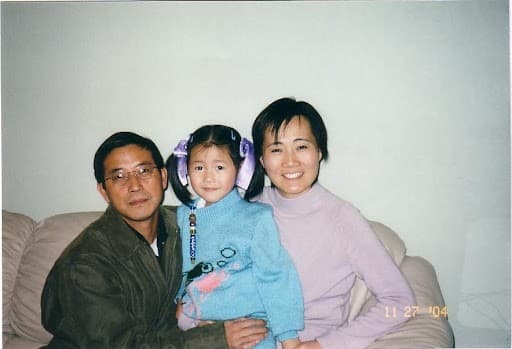
Shirley Chen is an actress living in Los Angeles. In her latest film SLANTED, she takes on her most intimate role yet, drawing from her own lived experience. Ahead, she reflects on the quiet, complicated evolution of her relationship with her immigrant parents.
SLANTED, to me, is defined by the language it has gifted me to encapsulate "I'm sorry," "I love you," and, more specifically, "I'm sorry for rage-Googling 'are you a bad daughter if you just don't like your parents as people.'" Phrases I fell short of throughout the full-throttle emotional whirlwind that is late-stage pubescence.
I sat next to my father at the SXSW premiere of SLANTED. A simple guy, his premiere fit was standard Asian Dad black-tie: a tan Calvin Klein hat from Costco, Polo Ralph Lauren button-up, a too-big gray blazer, and a pair of chinos—chosen because his original shorts were simply more casual than "business casual" implies.
In the opening scene of SLANTED, an elementary-aged version of my character, Joan Huang, sings "The Moon Represents My Heart" in the car with her father. Predictably, it is also a certified banger from the Chen father-daughter Carpool Karaoke rotation list. And just as Miss Teng—a Mandarin treasure as beloved as Whitney Houston or Adele for those unfamiliar—smoothly cooed "You ask me how deep my love for you is," my father leaned over to me and whispered, "I am so proud of you."
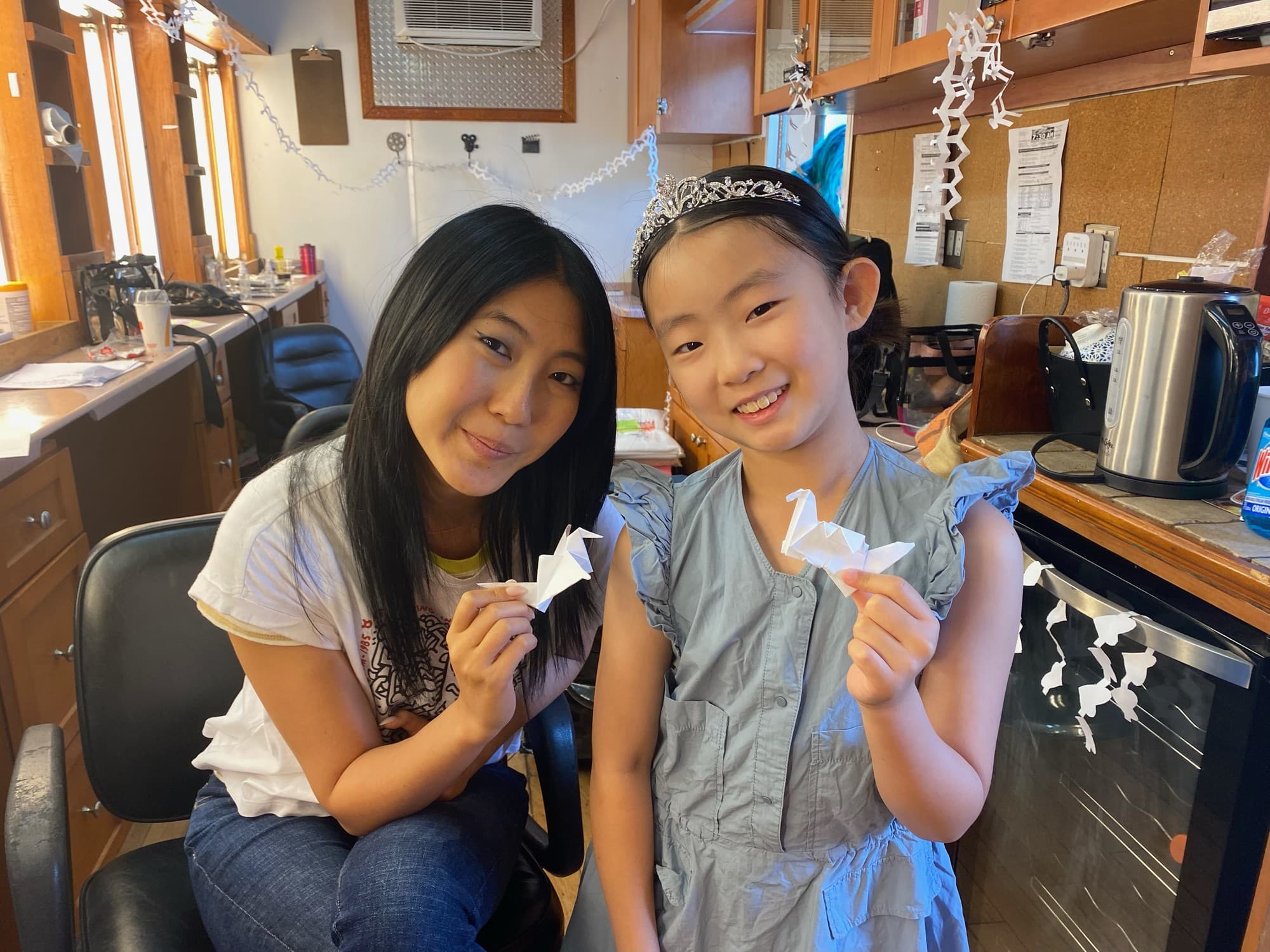
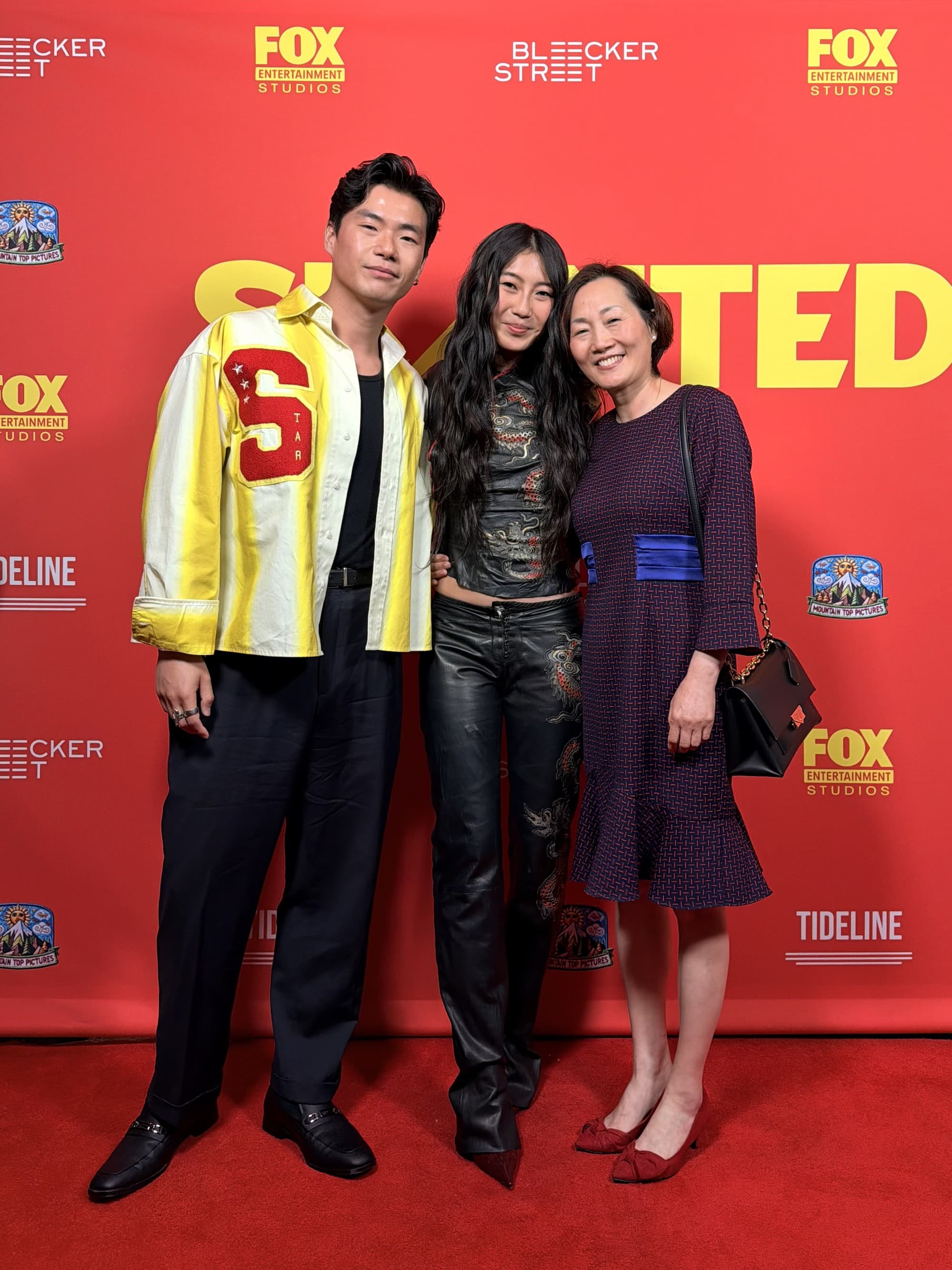
A year later, at the Los Angeles premiere, I sat next to my mother, who is markedly more hesitant to speak during movies. In one scene, my Joan—now an angsty 17-year-old—scarfs down her breakfast, and mumbles to her mother: “Speak English, Mom.” My mom chuckled. I’d forgotten I’d said that in real life to her. But I was mortified: if that rang true for my mother, then, categorically, I had been a bad daughter.
 Shirley Chen
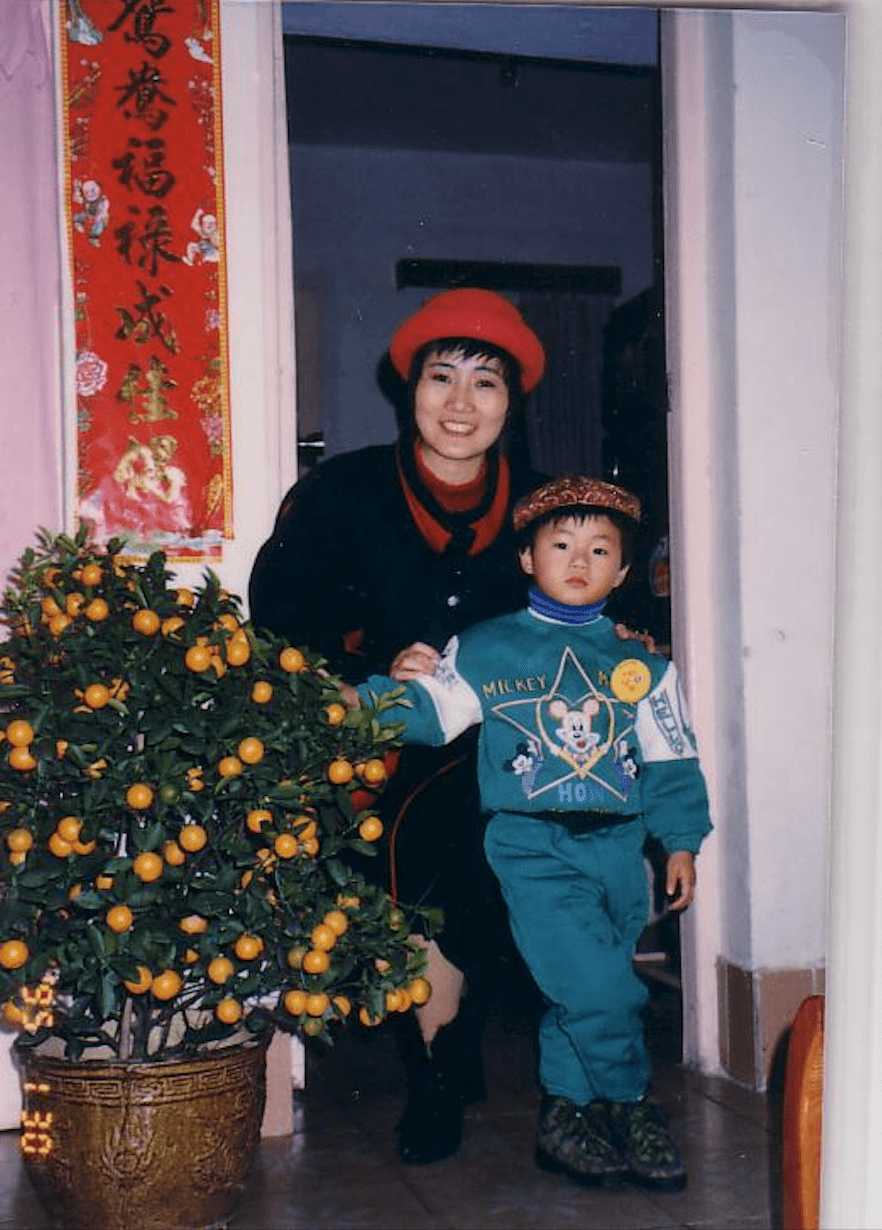
My parents crossed the ocean for me. Or, the promise of me. Via a now-defunct to-go packaging company that sold containers for other companies making food to-go, my father was given the opportunity to relocate his family—my father, mother, and older brother— to the US. Because of the One Child Policy, moving to America could materialize my mother's dream: a daughter. I stared enviously at the "fun" version of my mom in China: billowy pants with flowy sleeves, Blossom hats, neon blazer skirt sets that would have given Heather Chandler a run for her money. She and her friends posed in funny ways with odd architecture and pretended to strum guitars at picnics. She'd rock a pixie cut—androgynous before the word existed—that complemented her cheekbones. Her clothes were just as adventurous as her, and my humble dad, always beside her or behind the camera, boasted a sort of Gucci-model-type-of-handsome about him.
 Shirley Chen
But in the US, priorities shifted: with a newborn baby girl and an eight-year-old son, my parents practiced function over fun. My mom couldn’t bring anything she might only wear once, so she ditched her fabulous sets and kept only items that were well-suited for East Coast cold. She wore turtlenecks and big-tshirts and grew her hair down to her hips—not by choice, but because she couldn’t speak English and was afraid of seeming dumb at the salon. All decisions were made so that I could chase a new promise: not just life, but a better life. When I was four, my mom truncated her time in dental school to raise me. When I was ten, my mom moved with me to Los Angeles to help me pursue acting. My parents worked tirelessly, lived separately, all to chase a life that promised glamor, and I didn’t make it easy— I lamented speaking Mandarin at home (I hated being corrected) and argued constantly.
 Shirley Chen
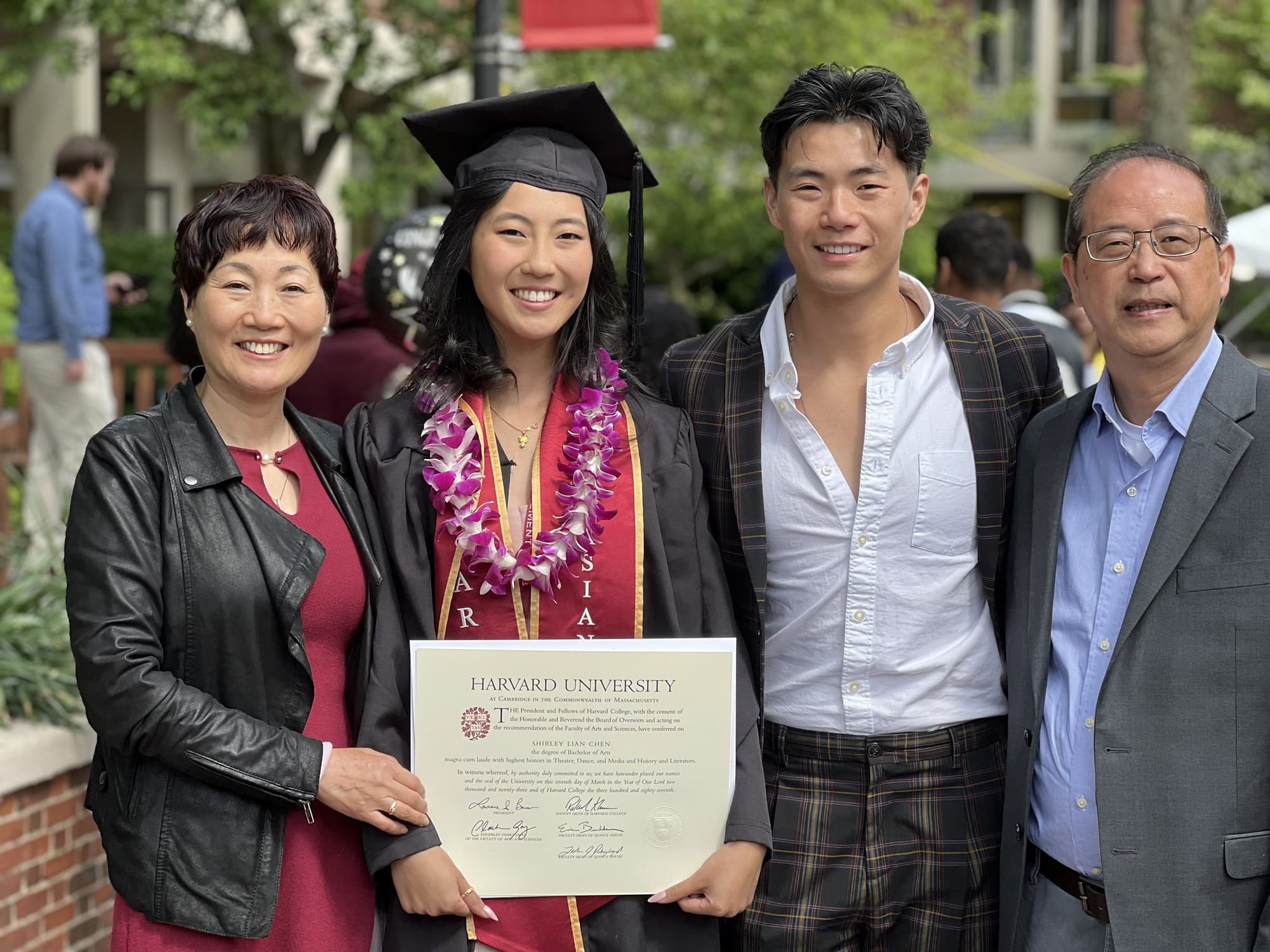
When I was accepted to Harvard University, suddenly it all seemed worth it. My mom cried, soft-bragged on WeChat, and wished her father could have lived long enough to see me admitted. I became proof my parents were good parents. So I’d finally done it— my Good Daughter Debt paid back in full, with interest. The American prophecy fulfilled: the legacy of individual sacrifices, risked on the condition of a promise for a better life for the next person. But when I graduated, the degree felt less like a personal feat and more like a relational bartering tool— a shorthand to signal intelligence, drive, and competence to strangers without my having to prove it. I started to feel real pressure, internalized, to live up to the idea of what I was supposed to be.
 Shirley Chen
For those rocky years after graduation, I felt a dissonance between my dreams and what my dreams represented to others. A conversation with my friend Molly shook me. She asked, “Isn't the fact that you were born already the achievement of your mom’s American dream?” It reminds me of one of my favorite lines from SLANTED: paraphrased, we become our own American. In the face of noise about what it means to have achieved—belonging, success— our existence uninhibited is enough. During filming, my dad visited the set and handed water to the crew. He rode Lime scooters with me across the Beltline and got to take pictures with Wu Jun Mei, an idol to him known in the States as Vivian Wu (my on-screen mother.) I got to include a real photo of myself, my mother, and my father in Joan’s living room. After my mom watched the movie, my mom opened up about something she’d never shared: she could relate to my character because, in China, she felt pressured to have big eyes, fair skin, a high nose. SLANTED gave words to a period of self-hatred that, through watching, I see my mom understand; I see an honesty in her I otherwise never would have gained access to. And for me, SLANTED is an opportunity to laugh about a time of my life that I try to forget.
 Shirley Chen
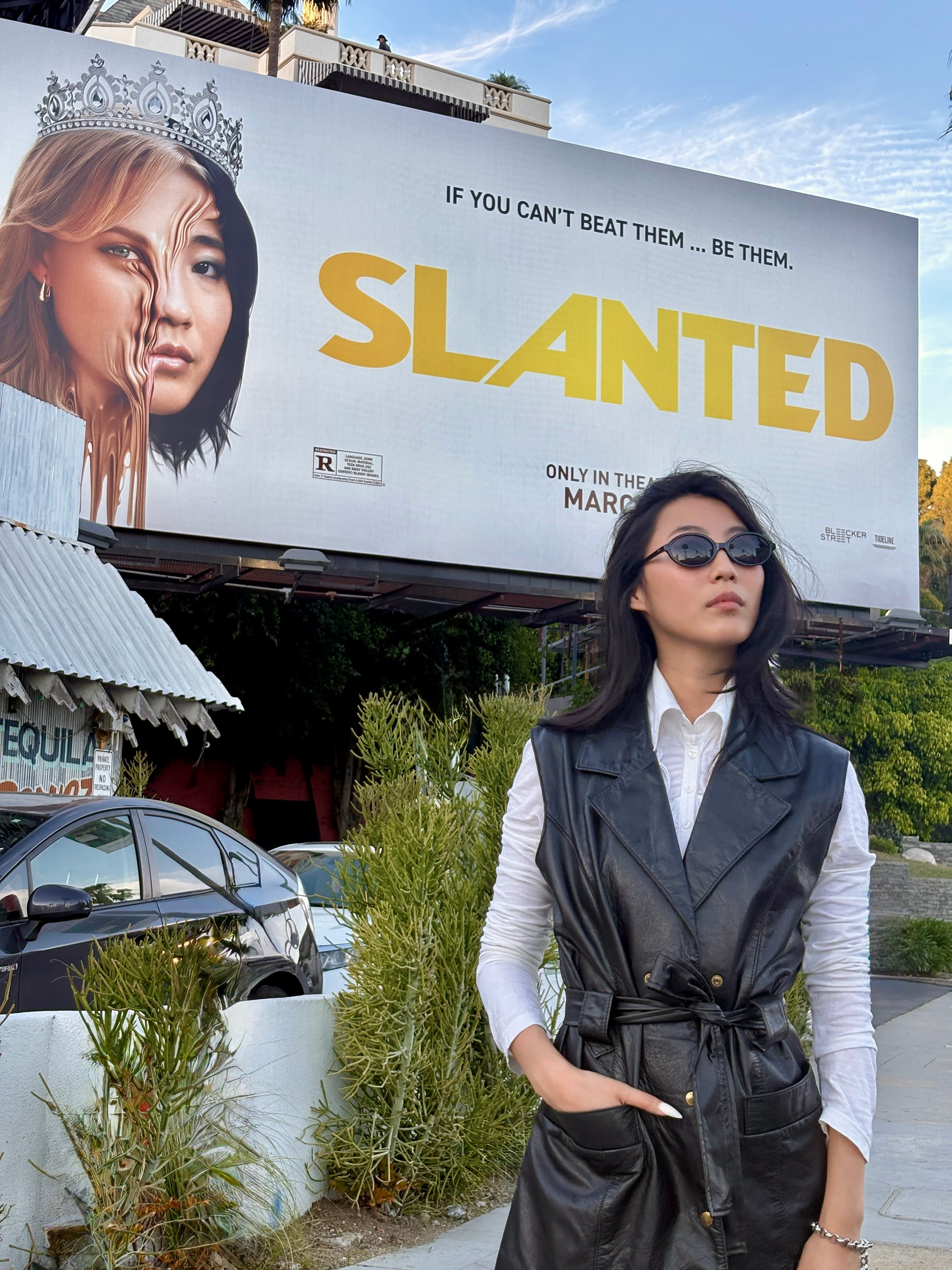
Our SLANTED billboard is now on Sunset Boulevard, the strip I’d wait on in bumper-to-bumper traffic with my mother after an audition on the west side that only went okay. When I booked my first series regular role this year, my mom, inspired by my dream fulfilled, went back to dental school. My mom and dad have long ditched their fabulous nerd-chic looks for hygienist scrubs and earplugs and factory bouffant caps, but to celebrate SLANTED, my parents dusted off their finest and played dress-up. My mom, who has since amassed a shoebox collection full of funky heels she will only maybe wear, got to finally break-out a pair of red kitten heels—her own version of Louboutins—to our premiere. I get to see their dreams realized, through me. In our family group chat, I think my mom summarized the point of SLANTED best when she responded to an AI-generated version of the poster: “meaningless if it doesn’t look like daughter.”