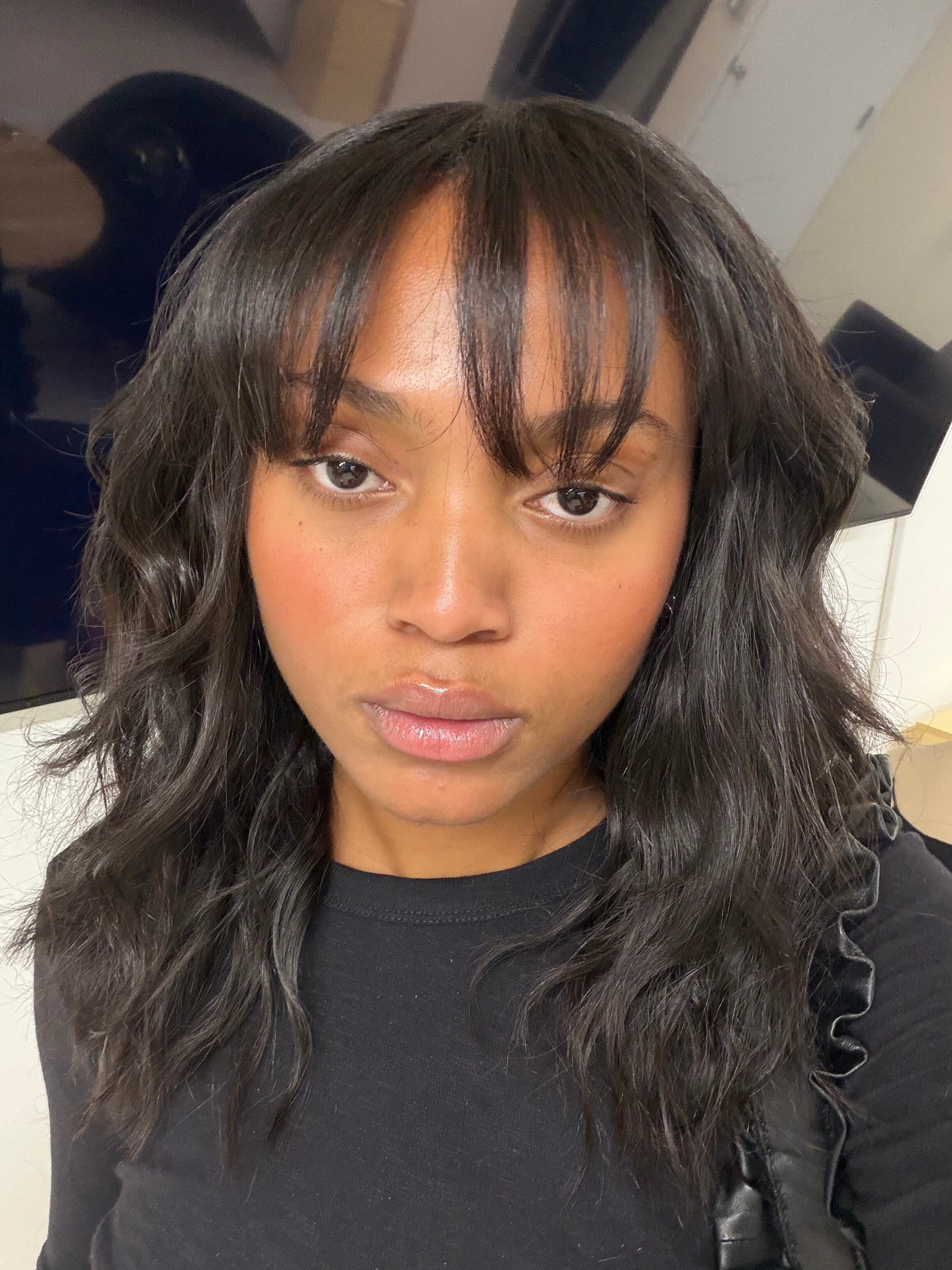
I've always told myself that if I were a white girl with wavy hair, I would have a fringy, shaggy haircut with bangs. It always starts as a nice, pleasant thought, but when it lingers for a bit, it becomes a little sad, like dreaming of something that you'll never have. I always thought that certain hairstyles—as well as the creative freedom to experiment with your hair—weren't options for me.
Growing up, I had little control over my hair. My mom relaxed my hair when I was young enough to not remember. I spent most of my youth and adolescence thinking that was just how it was going to be, and that heat damage, tamed curls, and ponytails were my present and future. I would occasionally turn to the same, consistent braids for the sake of giving my hair—and myself—a break, because I was always told that Black hair was too fragile, too weak to withstand much. My mom would share stories about growing up in Ghana and learning how to do cornrows at a young age, and photos of her with wild, untamed coily hair live rent-free in my mind. But now, as a white-passing woman in America, I can't really blame her for wanting to blend in—or for straightening her hair to do so.
I frequently think about an encounter I had with a boy I spent a lot of time with throughout my senior year of college, a relationship that I would now quantify as a situationship, but didn't have the terminology for. He touched my big, voluminous bun of cornrows and said, with an ignorant confidence that I've only ever experienced from straight white men, "You Black people and your fake hair," followed by a laugh, in one of my nightmares as a Black woman manifested. This is all to say that my relationship with my hair is complicated, forever fluctuating, and still unstable. But through keratin, a big chop, a mini afro, the process of growing out my hair, and always resorting to a slicked-back bun for the sake of not having to deal with my coils, I was getting bored—and could no longer accept that feeling restricted was my present and future. So, I decided to put fears of how white men would react to my "fake hair" aside and get a sew-in weave.
After being in awe of the hair at the annual Black Hair Reimagined showcase, I tapped True Indian Hair, a luxury hair brand known for luscious, unprocessed raw human hair. They connected me with Stacy Gray, a hairstylist with nearly 30 years of experience working on TV, films, and campaigns. I arrived at True Indian Hair's Midtown South store with washed hair under a camo baseball cap, hoping for waving collarbone-length hair with face-framing layers, and with no idea what a closure or leave-out was. I felt a sense of shame for my lack of knowledge and because, as a Black woman, I had no prior experience with weaves. It was similar to the shame and embarrassment I feel when I don't pick up on Black American references or admit to never having seen certain Black American movies because I didn't grow up in a Black American family.
That shame quickly dissipated when Gray took the time to sit down and chat with me about what I wanted out of this experience, my first rendezvous with "fake hair." "Earlier in my career, the goal for many of my clients was for their hair to look as natural as possible. Wearing a weave was not always something most openly discussed," Gray says. "Women wanted to enjoy the look without anyone knowing how it was achieved. Over the years, I’ve seen more women become comfortable talking about extensions and having fun with their options, but that judgment hasn’t disappeared." She told me that she has had clients return the next day to have their weaves removed—not because they didn't like the look, but because their husbands didn't approve of them wearing "fake hair."
For Gray, her ultimate goal is to educate people about their hair and how to keep it healthy. I felt taken care of and that, even beyond that appointment, I had someone to turn to with hair questions—the perfect example of how Black women tend to take care of each other. Not quite in these words, but she committed to being my Black hair whisperer. "As a stylist, I understand that someone sitting in my chair is trusting me with more than their appearance. I’m listening to how they want to feel and caring for the hair they’ve entrusted to me. I remember how my first weave made me feel, and I carry that understanding into my work," she says. "For many Black women, hair is deeply connected to our identity, our culture, and how we express ourselves. It carries history, family traditions, and memories of who cared for us." On top of this, Black women have always historically felt pressure around what our hair is supposed to look like—and, when left naturally, are often criticized for not being beautiful, put together, or professional.
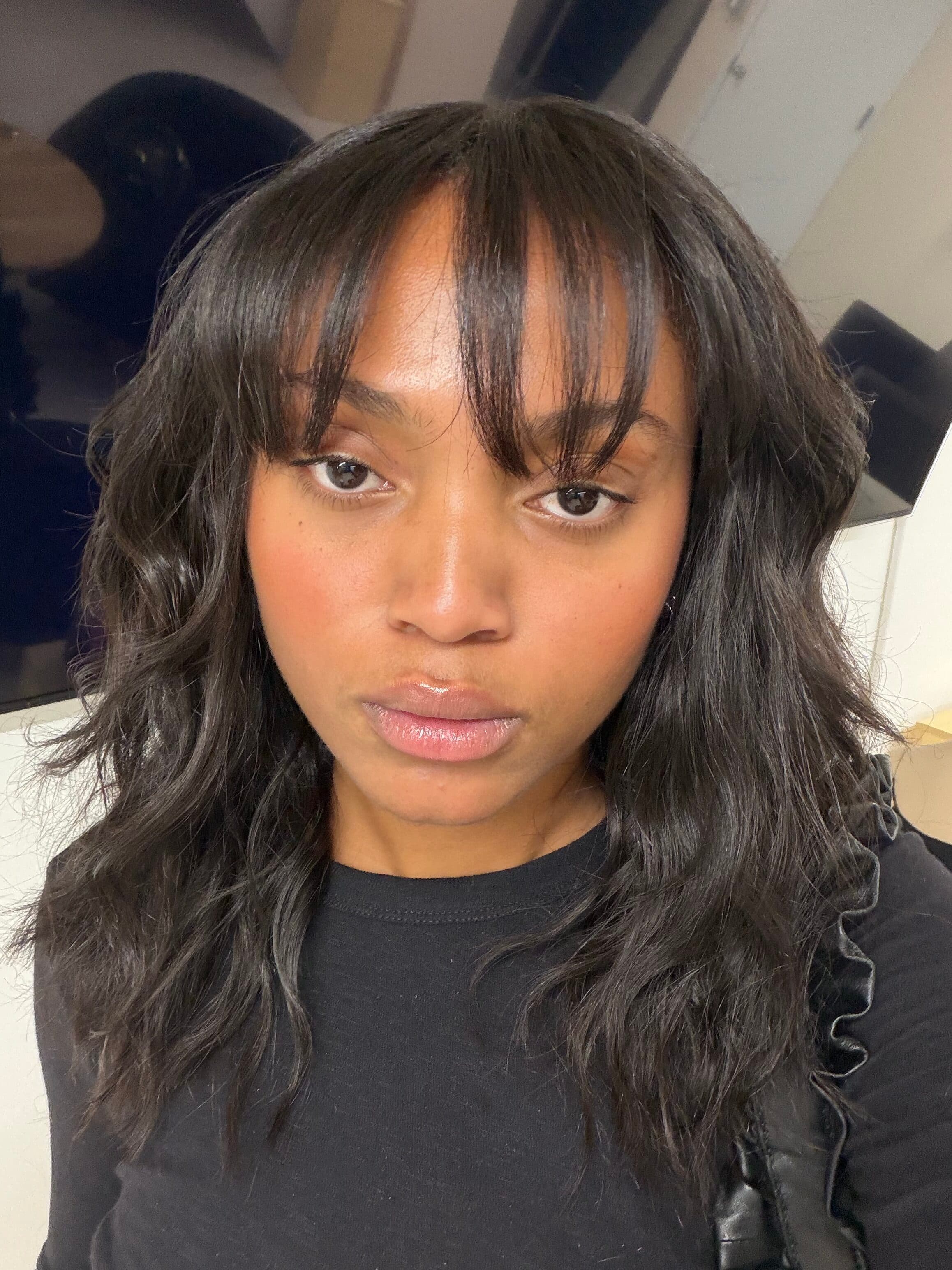 Photo: Bianca Asare
I went into the appointment with only a vague idea of the look I wanted. Through an afternoon of music, singing, watching myself transform before my eyes, collaborating, and deciding together that taking a big swing was so worth it, I ended up with a look that I previously thought I wasn't allowed to have. We moved forward with a full braided sew-in using a 5-by-5-inch closure, which Gray explained as a small piece of lace that goes on top of the head to mimic the appearance of a natural scalp. For the finished look, we chose wispy bangs, soft waves, layers, and a fringy, shaggy finish with lots of body—aka the hairstyle of my very hypothetical white girl dreams.
Sew-ins are a Black culture staple. They offer Black women, often criticized for having hair that's messy, fragile, and difficult to deal with, a route for self-expression and an opportunity to experiment with our appearance. "Extensions give us options. We can change our length, volume, texture, or color without making a permanent change to our natural hair," Gray says. "Wearing a weave doesn’t automatically mean a woman dislikes her own hair. It can simply mean she enjoys variety or wants a particular look."
I've felt the significance every day since getting my sew-in. Sometimes I look in the mirror or receive compliments and feel a sense of guilt about not growing this hair myself. I've also wondered if I should explain that this isn't what I look like naturally. At the same time, I feel like I'm finally finding power in my Black womanhood and embracing all the traditions that come along with that. Most surprisingly, I now can't imagine not having bangs.