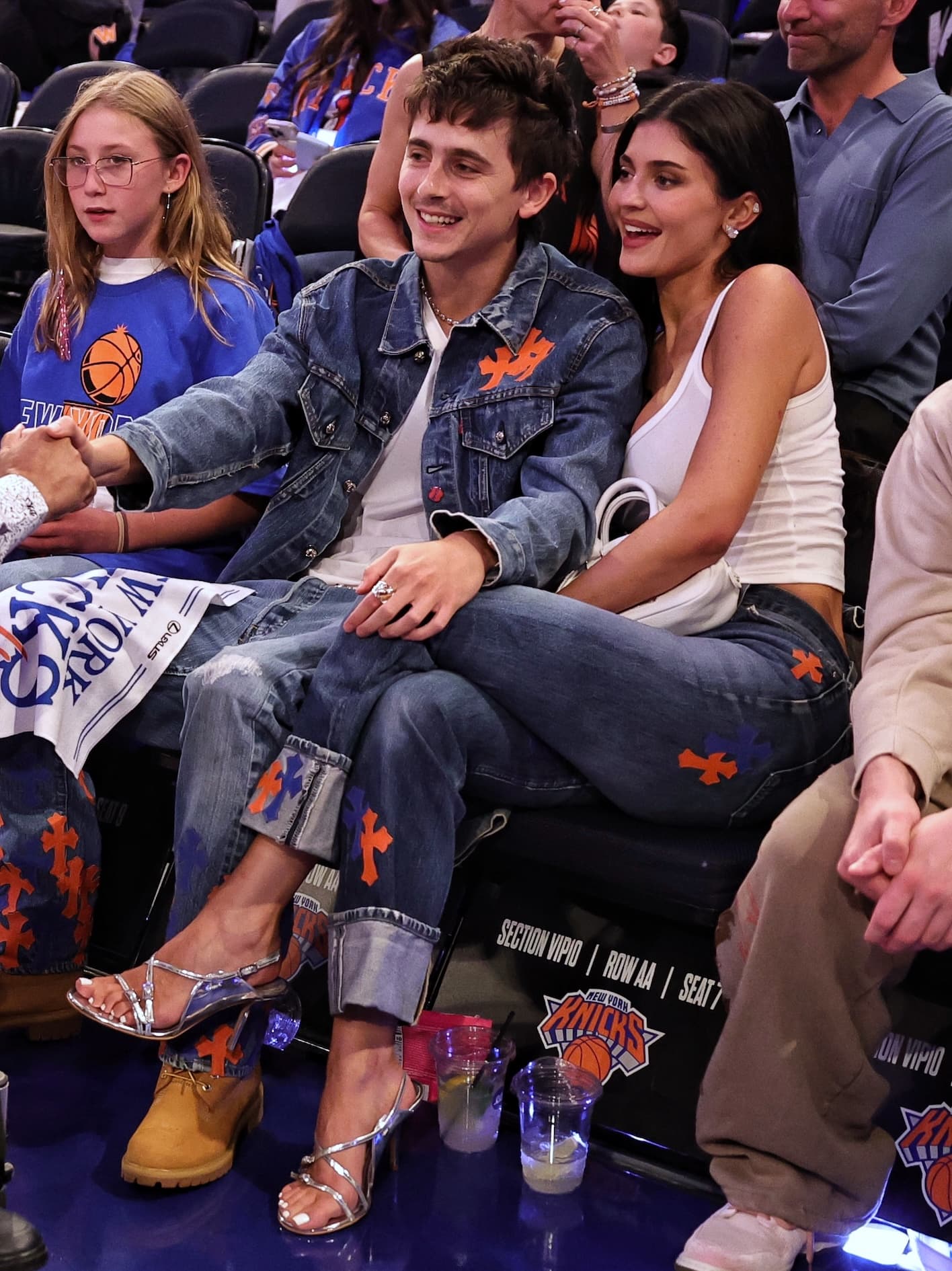
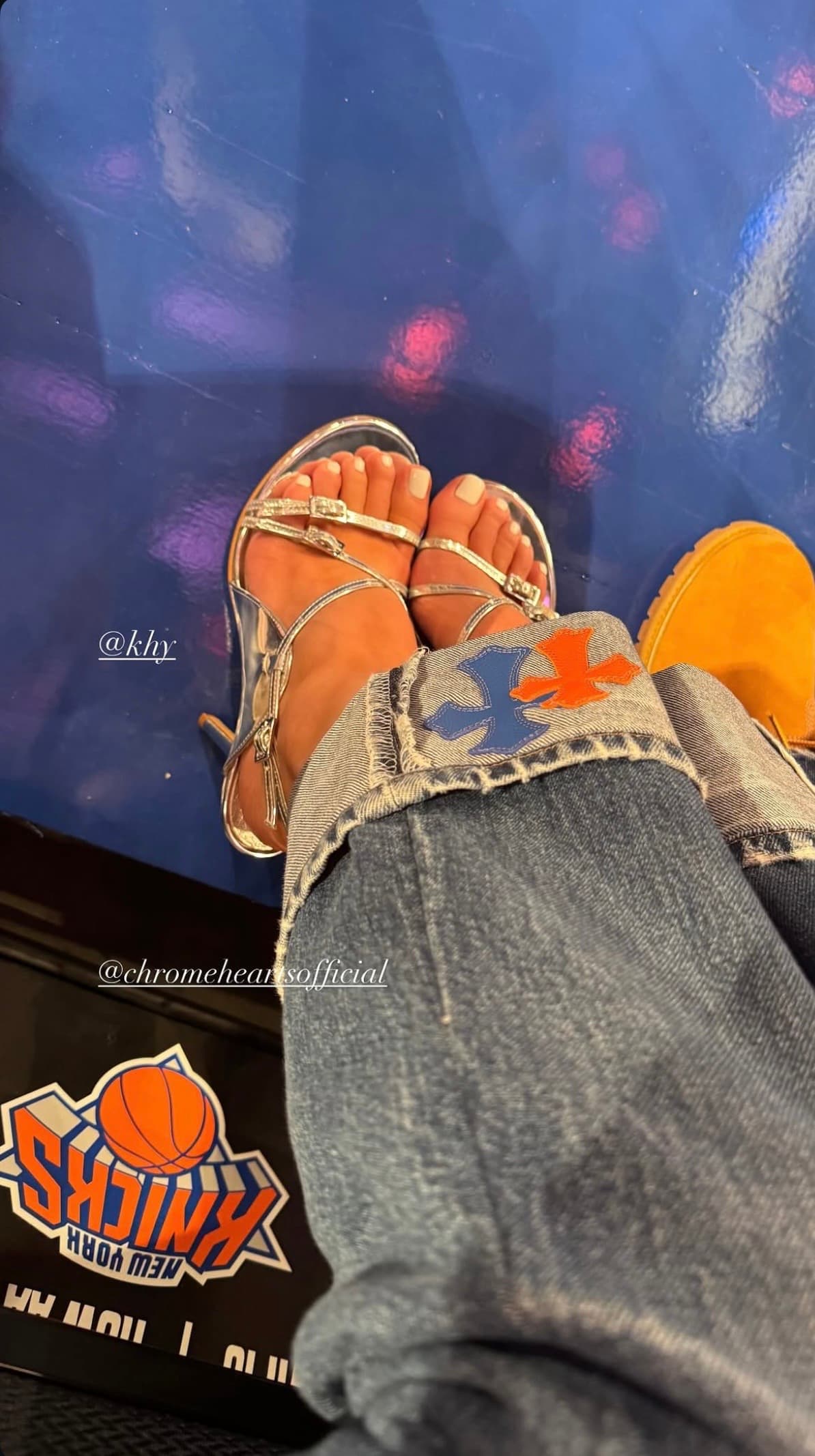
You’ve noticed the brand codes before: a cross logo, that old English font, a placement on all of the most style-tapped celebrities—including Timothée Chalamet and Kylie Jenner at the Knicks game last night. Chrome Hearts is the elusive, tightly controlled fashion brand that Gen Z heavily covets. In a time where quiet luxury has been established as the true symbol of wealth and success, younger generations are pushing back and Chrome Hearts has successfully pierced through—so much so that they’re willing to drop $25,000 on a pair of jeans reminiscent of the unapologetic maximalism and piercing loudness of the Y2K era. With celebrities like Timotheé Chalamet and Kylie Jenner in matching denim at the Knicks game last night and Charli XCX at the 2026 Grammys, for example, inspiring hefty purchases, Chrome Hearts has a particular chokehold on Gen Z—one so strong that we can only think to compare it to a brand like Supreme.
According to luxury fashion sourcer Gab Waller, Los Angeles is the Chrome Hearts hub—it’s easy to spot a handful of twenty-somethings sporting the brand in some shape or form on a day out. “It’s the effortlessly cool LA aesthetic,” Waller says. “They're wearing Chrome Hearts with their slippers or their Uggs to walk around in Beverly Hills.” Waller often receives requests to source Chrome Hearts, especially in the last two to three years. “In 2025, Timothee Chalamet wore a Chrome Hearts zip-up and I got an influx of requests from that,” Waller says. Sourcing Chrome Hearts isn’t a simple task, though—it’s not a store that just anyone can walk into. This is, perhaps, the major difference between Chrome Hearts and Supreme: the latter operated on a consistent drop schedule. With Chrome Hearts, you never know when an online drop is coming and they happen only a handful of times per year, you can only shop a Chrome Hearts storefront with an appointment and, even so, the stock is very limited. So, the brand owes its popularity to one particular mindset: “They want something that other people don’t have,” Chrome Hearts reseller and founder of ByRaph Raphael Badalov says. It’s all about exclusivity.
The interior of a Chrome Hearts store is more museum-like than anything else—this is just one more element that contributes to the mystery surrounding the brand. “I think Chrome Hearts has been very effective at establishing a sense of community combined with product scarcity. The Chrome Hearts business model borrows from luxury on pricing and perceived exclusivity, streetwear on continuing fresh drops, and community marketing on its cult-like following,” Luca Solca, Managing Director and Global Head of Luxury at Sanford C. Bernstein says. “Its stores are so different. They create a ‘stage’ rather than a commercial venue.”
Chrome Hearts is, at its heart, a family business with an air of mystery surrounding it. “As I started getting closer with the Chrome Hearts family and I got much deeper into it, I realized they literally don’t care,” Badalov says. “They don't care because they know people are going to buy their stuff. If you're tight enough with them, you can go and order a couch for a million dollars. It might take five years for them to make that couch, but that’s Chrome Hearts.” Badalov is a 21 year old entrepreneur who, over the past two years, has made a fortune reselling solely Chrome Hearts. From t-shirts for $1,000 to jackets for $200,000, Badalov has successfully filled a gap in the market and capitalized on the fact that young people everywhere will go to great financial lengths to get their hands on a (or multiple) Chrome Hearts piece. After some time, Badalov was banned from all Chrome Hearts stores as he claims they “pretend” to not align with resellers. Through first hand experience watching people with the intent of purchasing something at a Chrome Hearts store get denied and after being banned worldwide, he learned that being denied access to something fuels people. Enough so that they are, in turn, willing to spend ten times the money to gain that access.
“The celebrity approach, I would say, is really what's taken off. But I also feel it is that brand that you really are buying into, even though I don't think they've done this intentionally. I think it's just happened organically. It's a bit of a community,” Waller says. “It's very much that you're wearing Chrome to be a part of a cool club.” It’s micro celebrities with smaller internet followings giving Chrome Hearts this sense of exclusivity and covetability, too. A social media personality known as @sweetsound coined the “Chrow” aesthetic: the pairing of Chrome Hearts pieces with pieces from luxury brand The Row, as a way of merging quiet luxury and more of a loud, logo-heavy brand. “I see him out at coffee shops and he’ll be wearing Chrome and all of these young guys are running up to him saying ‘oh, you’ve got the Chrome Hearts shorts!’,” Waller says. “He’s had a massive influence on young guys wearing Chrome Hearts.”
It’s easy to land on the theory that the brand’s popularity has very little to do with what they’re actually selling. Instead, it has everything to do with the fact that celebrities like Bella Hadid, Charli XCX, Drake, Kim Kardashian, Kylie Jenner, and Timotheé Chalamet endorse the brand, and the brand’s products are nearly impossible to get your hands on. So, when you purchase a Chrome Hearts product, you feel special, akin to celebrities walking red carpets in custom looks, and like you’re part of a very exclusive club.
 John Salangsang / Shutterstock
So, why is a brand that Jay Z was wearing back in 1999 seemingly having a moment in 2026? And why and how is this what Gen Z is choosing to spend money on? Chrome Hearts arguably fits into the dark, gothic, and rock aesthetics popular amongst younger generations on social media. The world is dark and young people don’t want to hide the reality of that. Instead, they want it to be reflected through what they wear and the content that they post—and, they want to feel rebellious. Chrome Hearts simultaneously feels underground and niche while also serving as a major status symbol—plus, Chrome Hearts pieces are collectibles. “[In 2026], people have less things to collect,” Badalov says. “Aside from the collectors, kids just love to blow money. Kids that are making money as traders or whatever businesses that people are starting, they just love to spend money.”
 Matt Baron/BEI / Shutterstock
What’s most interesting about this successful business model, though, is that it seems to have happened accidentally. “I realized that they literally don't have the capacity to produce,” Badalov says. “They're operating out of a ten or fifteen thousand square foot factory in LA. That's it. They have no other means of production and they simply cannot keep up.” And when you’re selling couches for a million dollars and receiving special requests from rappers like Playboi Carti, they don’t really need more employees or production space even though they have the means to expand. The brand’s momentum seems far from slowing down. With their limited production and general discreet nature continuing to appeal and continuous celebrity endorsements, the brand seems to grow more sought after by the day. “There’s the classic saying of what goes up must come down. But Chrome Hearts has maintained that for such a long period of time that I don't see it going anywhere anytime soon,” Waller says. “I feel that it's almost just steady. It doesn't feel like it's absolutely exploded to the point that it's going to come back down.”