I am currently in the process of lasering almost all of my tattoos off. I got my first when I was 16—my own handwriting of my sister’s name on the inside of my upper arm with an arrow shot through it, just as I had seen on Tumblr. I figured it was a safe choice being my sister’s name. It never occurred to me, at 16, that I'd want it off my body because it “just isn’t my style” anymore.
The same thing happened with the rest of the tattoos that patchwork across my right arm. I swiftly dropped the idea that everything I permanently put on my body had to have meaning. So during a brief period of dating a Slovakian skater-turned hopeful tattoo artist who would tattoo me at my kitchen table, within a few months of early adulthood I had various scripts, slogans, and words scrawled across my body. I wasn’t connected to any kind of subculture (unless you consider Freja Beha and Erin Wasson subcultures), and the tattoo trends of the 2010s were mostly small tattoos, line drawings, handwritten words, and tiny pictures, so getting rid of the poorly thought-out decisions of my youth hasn’t been too stressful of a process. But when I am in the laser room feeling like someone is tracing a hot poker over my flesh, I think about all of the other people who devoted their skin to a certain tattoo trend du jour only for it to go out of style mere years later. Are you all regretting your post-ironic “swag” back tattoos just as I am my line drawing of a woman’s torso?
Cybersigilism & Memetic Tattoos
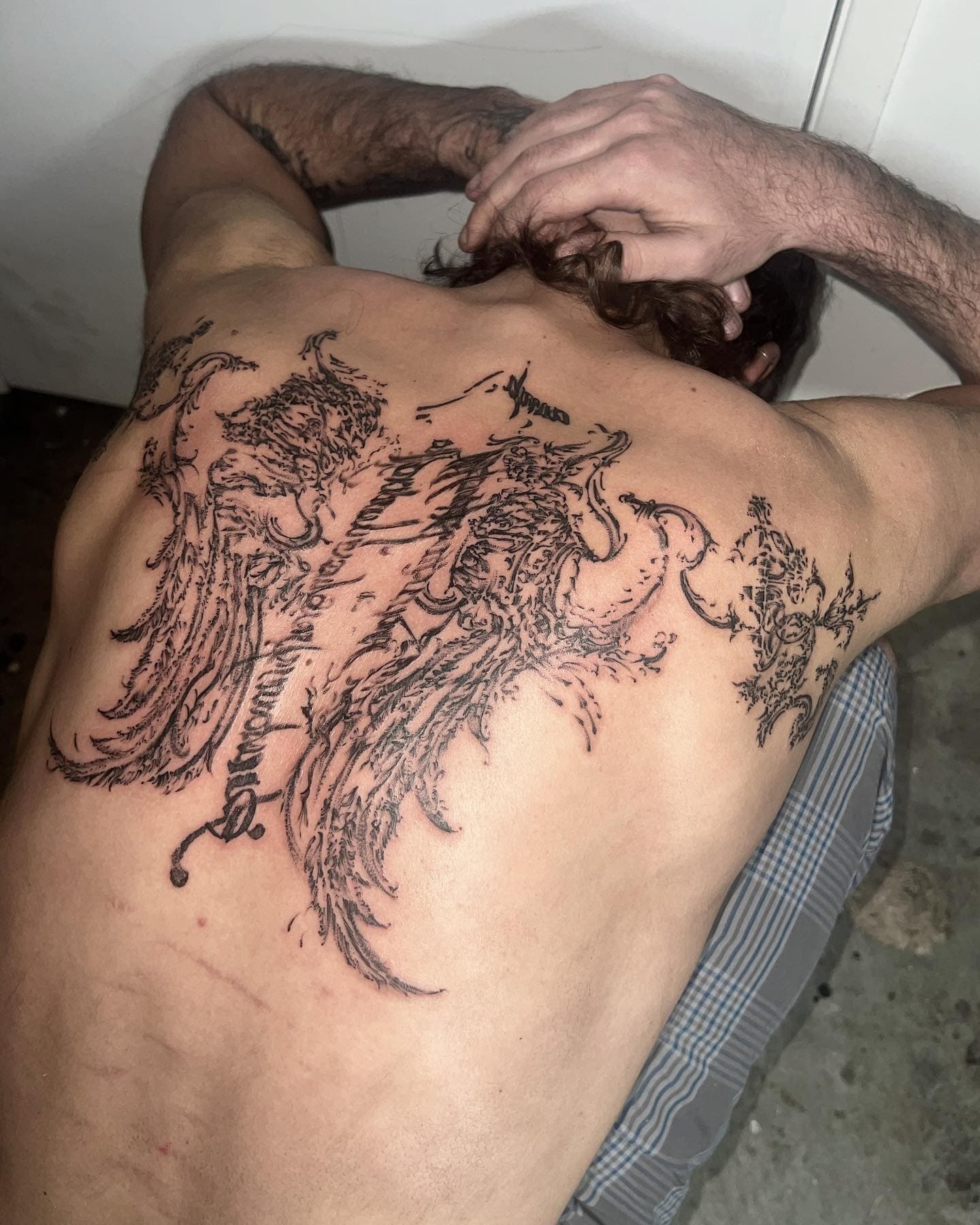
The 2020s have been a big decade for tattoo trends. Cybersigilism, post-ironic, memetic tattoos, and religious iconography have all surged in popularity, alongside nostalgic, Y2K-style tattoo placements like tramp stamps, bicep tattoos, and back tattoos. “A trend is a collective movement outside the body, reflected and mimetic, repeated externally," tattoo artist 6th House says. “A style carries its own recognizable aesthetic language, a lineage of meaning, so when a style becomes a trend it acts as a kind of cultural tomb, marking a moment, a shift, a technology, a mood, or a collective memory.”
“I think when a style becomes trendy it's really cool to see mass amounts of people resonate with the same style, and it's super sick to see artists get recognition for bringing the style into popularity.” Madison, an LA-based hand poke artist whose work heavily draws on script, religious iconography, and decorative design under the handle Piiiinkslip, shares. “I really just appreciate that we even have the opportunity for styles to trend. It really speaks to the evolution of tattooing in society, and how there's been more acceptance.”
The Rise Of Intellectual Tattoos
Pew Research Centre claims that Gen Z are getting inked more than any other generation, and the research suggests that 69% of tattooed adults say that getting tattooed to honor or remember something is a factor in getting tattooed. But according to our algorithms, a more ironic approach is being taken to ink, reflecting the apathetic attitude of today’s youth. The rise of AI hasn’t done much by way of trends either, and the conversation around taste versus AI slop has carried over into tattoo discourse, where post-ironic styles and Cybercigilism somewhat visually combine to create the “intellectual” tattoo microtrend. Diagrammatic tattoos take on additional philosophical or spiritual meanings to buck against our collective reduction in intellectualism in the age of AI. Almost all tattoo trends return to what we know about trends in general: they mark a time in history and reflect the feelings, sentiments, and cultural cachet of an era.
“I started tattooing in Berlin in 2020. At that time, an aesthetic of decay was very present and pulsing through the city, mixing and interweaving Gothic architectures and figures, faces and geometric shapes, organic vines and jewellery, all brought together in this mosaic of ink, darker and lighter shading techniques, embracing imperfections,” 6th, whose ornate style is instantly recognizable, recalls. “I think that this was the beginning of tattoo artists who were confronting us with the reality of entropy and the impermanence of the skin, a challenge against the perfection of a 'clean' aesthetic. Through the lens of the times, post-Covid, I also think it was a challenge to prevailing truths of structure, of certainty, of the straight line as authority. When the world revealed itself as unstable, the clean line lost its claim to truth.”
For Madison, her Filipino heritage and the traditional handpoke practice Tatak, merged with visual inspiration from wrought-iron designs by Black Americans, blends both of her cultures into a physical and visual practice that grounds her style in her cultural identity. “Part of the reason why I started handpoking was because of my Filipino background…I think handpoking being tied to part of my culture just made me love it even more,” she explains. “I take inspiration from the buildings and homes in NYC especially. Those decorative patterns you see on wrought iron gates are tied to Andikra symbols that originated in Africa and were popularized in American architecture by African American blacksmiths in wrought iron designs.” From her perspective, the style of tattoo is as enduring as the skin that bears it. “Although different tattoo styles trend online and come and go, there will always be a space for them. I don’t think I’ve ever heard of a style being cycled out, which is why I love tattoos. There’s literally something for everyone.”
The Cultural Influence Of Tattoo Styles
While any tattoo that you assign meaning to counts as a “meaningful” tattoo, there are some that are linked to cultural practices that are entirely emancipated from the trend cycle. The traditional Māori tattooing practice, tā moko, is used to show ancestry, status and spiritual identity, similarly to the tattooing practices of Indigenous Americans, which is also part of a coming-of-age practice in some communities; Irezumi and Tebori are the traditional tattooing practices of Japan, while the traditional American tattoo style has roots in sailors as early as the 19th century, and is one of the most enduring and popular tattoo styles today.
“Understanding that intention for yourself, as well as where a symbol comes from and who makes it, is all part of the process. I think of tattooing as an extension of memory, and as a way to heighten our waking life.” Says 6th. For them, understanding the origins of a tattoo style is one thing, but understanding yourself is the most important tattoo prep one can do. “When I'm asked to make a tattoo with someone, I encourage them to meditate on their own internal shifts, language, and aesthetic preferences first,” they say. “My philosophy is that tattooing should be an active choice, one that aligns with what the wearer genuinely feels, believes, and is drawn to. If a style becomes a trend and the wearer isn't actively choosing it for themselves, it risks sitting out of step with their longer relationship to their own body. Like in Buddhist teachings, staying present with yourself, regardless of what's trending, is what lets you engage with what you truly like, inside or outside of any trend.”