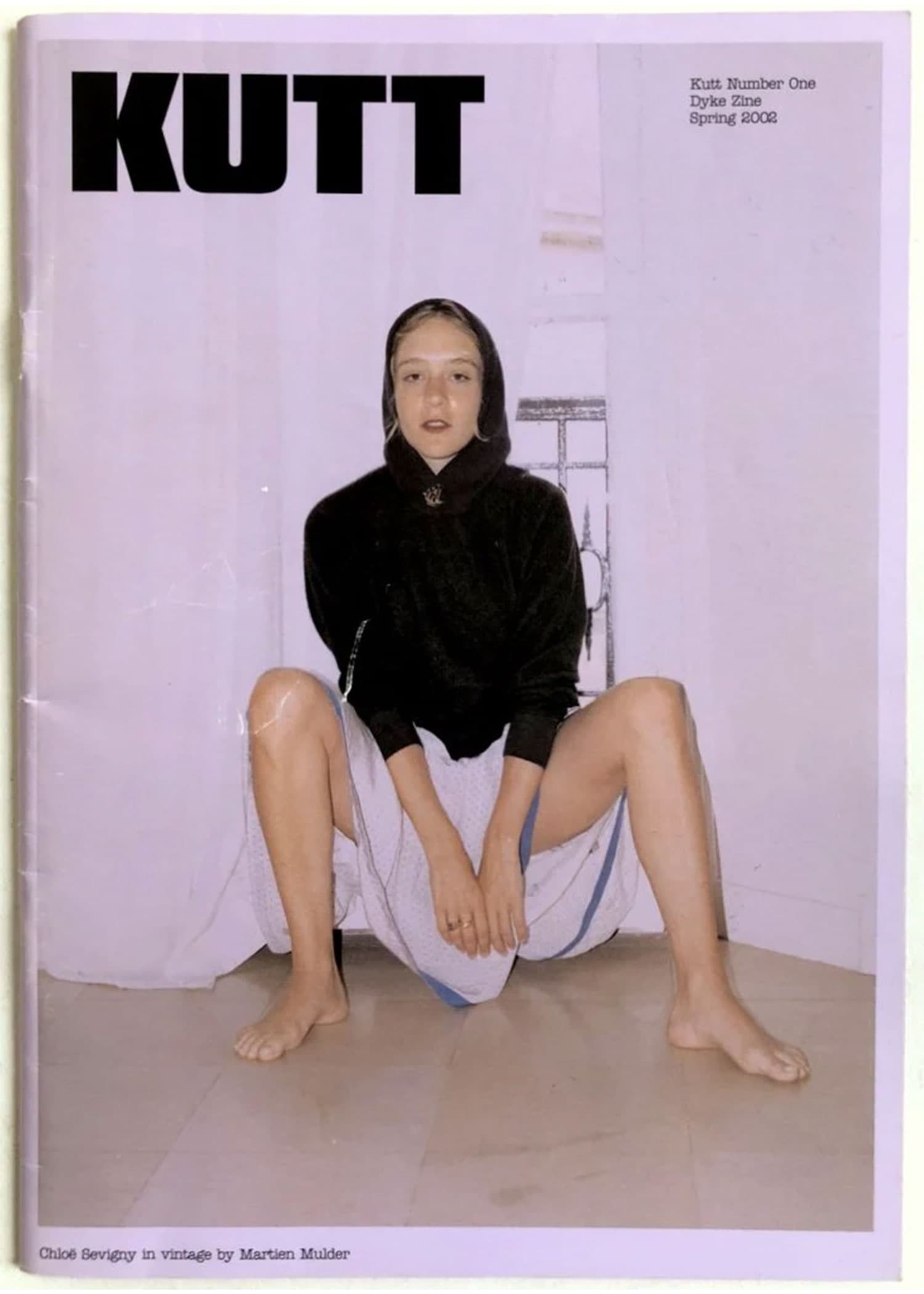
It was 2002 when Jessica Gysel was at a bar with the founders of BUTT magazine, the cult gay magazine known for its explicit photography and candid explorations of the gay experience. At this bar, Gysel and BUTT founders Jop van Bennekom and Gert Jonkers began to talk about what a lesbian counterpart might look like. So they birthed KUTT, helmed by Gysel. With the branding and backing of the already established BUTT, Gysel put together one of the first lesbian magazines that occupied a spot in the intersection between identity, fashion, culture, and sex.
Between 2002 and 2003, right before projects like The L-Word catapulted lesbians into mainstream media, KUTT took off, publishing three issues over the course of the year. The first featured Chloë Sevigny—famously an honorary lesbian—on its cover, a moment that Gysel tells me was a favorite since the actress was someone she “had a bit of a crush on.” The pages within featured photo spreads by the image-makers of the era: Ryan McGinley, Collier Schorr, Viviane Sassen, Martien Mulder and more. Words by acclaimed writer Eileen Myles accompanied, with additions from K8 Hardy and Merrill Nisker (Peaches).
Despite its creative pedigree, KUTT lasted just three issues. Gysel felt that since there was so much of BUTT’s branding in the DNA of KUTT, and ultimately, what lesbians needed out of a magazine was not the same as the kind of gay stories van Bennekom and Jonkers were exploring. “In the long run, the reason why we stopped was that it was complicated and I felt I couldn't really do what I wanted to do,” she says. During that time, Gysel notes, gay visibility was far further along in media and in culture than lesbian representation was, and so navigating those nuances became a complicated task, especially as a counterpart publication. “I think it's a lot easier for gay men to make something,” she says. “For me, it was difficult to follow their editorial guidelines and make something that wouldn’t put us immediately back in some kind of closet or underground.”
The difference between gay and lesbian communities is vast. There is, of course, the camaraderie in shared struggle and friendship to be found within these intersections. Yet, the predominant difference lies within the patriarchal systems in which our society operates. Gysel notes that creating a lesbian magazine focused on sex in a society that exists under patriarchy—especially one that is so exposed to porn—was a complicated task. “I struggled a lot with the sexual aspect and how to do that,” she says. “We did a mud wrestling feature, which I liked, because it's something that lesbians took into their own hands as reappropriating the male gaze.” But it was hard, she says, to not end up in the porn realm. ”To be honest, I still don't have the answer for how to do it and avoid that.”
 Photo: IDEA
Gysel notes that there are classic lesbian magazines like Curve and Diva that occupy more commercial spaces to this day, but few queer magazines with a lesbian or women-focused lens exist in the fashion publishing space. In author and professor Jan Whitt’s research paper, A “Labor from the Heart:” Lesbian Magazines from 1947-1994, which was published in the Journal of Lesbian Studies, Whitt notes that gay male publications historically had greater circulation, more consistent advertising, and a glossier commercial model, whereas lesbian publications were substantially less financially secure, making them a “labor of love that rarely survived.”
The sentiment is backed up in Georgia Turner’s chapter, “Producing a Lesbian Magazine at the Turn of the Twenty-First Century” in the book Women's Periodicals and Print Culture in Britain, 1940s–2000s, where she says that lesbian publishing was “relatively short-lived, made on a low budget and published irregularly,” suggesting that both direct political suppression and more subtle commercial forces, particularly difficulty attracting advertisers and reaching readers, led to their demise.
Famously, BUTT magazine returned in 2022 after a decade-long hiatus with the support of Bottega Veneta, but no such luck came for KUTT’s resurgence. “There's never been a brand like this coming to us,” she says. “I find it very frustrating.” The name has only been in the media recently because the entire KUTT library is being reproduced by IDEA, bringing all three issues together in one volume.
In a moment where many countries are trying to walk back LGBTQIA+ rights and the acknowledgement of the queer community's existence, lesbian source material—publications, literature, and media at large—feels more important than ever to invest in. With the present-day struggles of print media, economic limitations, and anti-gay sentiments on the rise, it also feels far away.
Lesbian literature, language, and resources have always existed in the shadow realm of queer culture. In Carmen Maria Machado’s seminal memoir, In The Dream House, she points out how under-represented lesbian stories are, including the ugly ones, leaving many lesbian women without the tools to navigate their lived experience, for lack of documentation of those who have come before them. “I enter into the archive that domestic abuse between partners who share a gender identity is both possible and not uncommon, and that it can look something like this. I speak into the silence. I toss the stone of my story into a vast crevice; measure the emptiness by its small sound,” she writes, offering confirmation that people care less about lesbian stories simply because they care less about women’s stories.
While there are plenty of emerging platforms, we still have a long way to go before lesbians, alongside trans people and queer people of color, are represented and platformed in the same way gay men are, who still have a dog in the fight. “There have been a few more fashion-oriented lesbian publications I think in the last five years,” Gysel notes. “But they also disappeared. I think there are still a few online, but there were a few publications, and then they came and they went.”