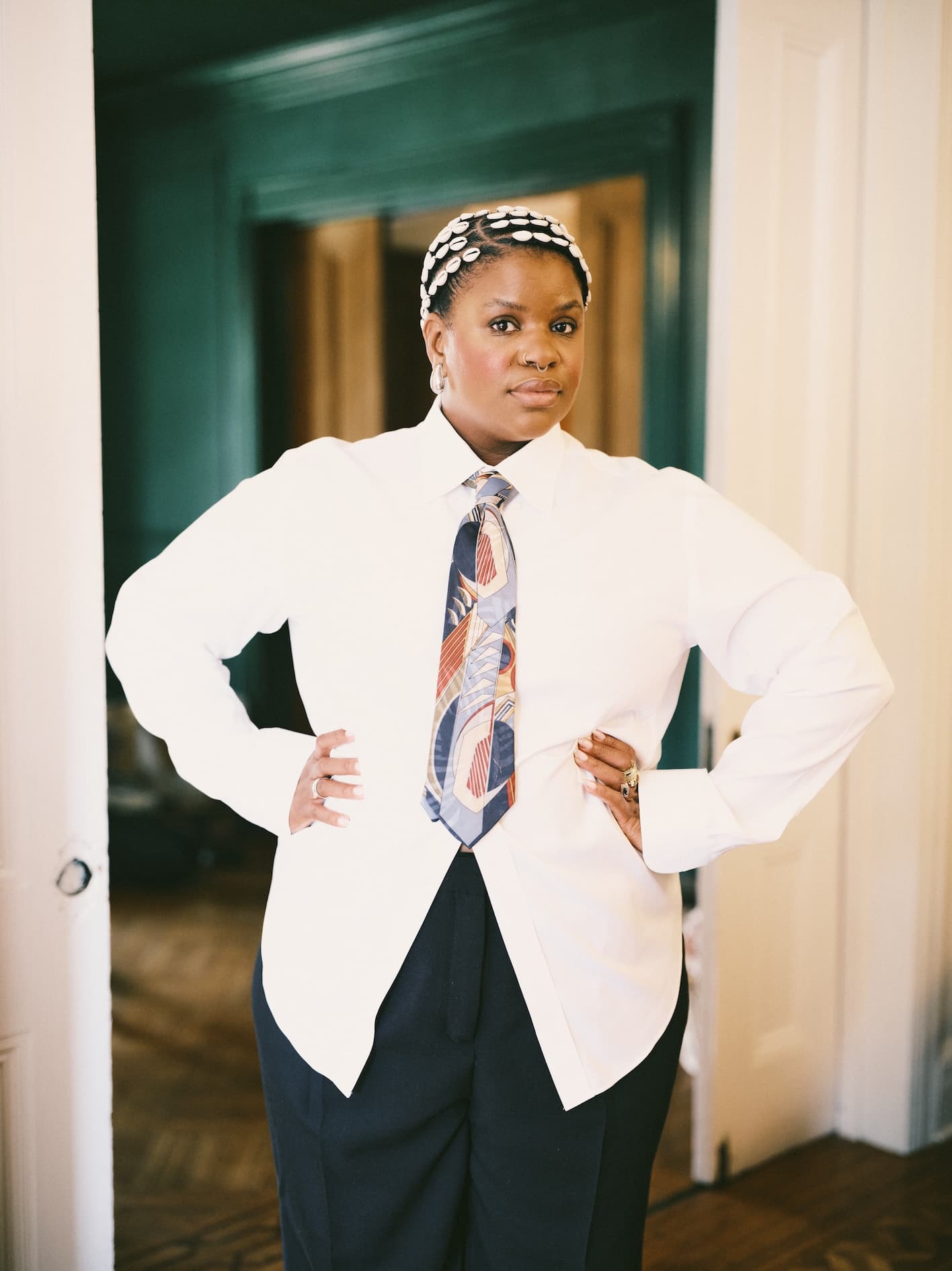
If you scroll through Black queer sex educator Ericka Hart's Instagram page, you'll find reels featuring tidbits of sex-ed and political commentary broken up by product hauls, interior design content, and reality tv recaps that are still grounded in this truth: everything is always about race. "I started watching Love Island to turn my brain off, but I just couldn't," Hart tells me. "I couldn't look away from the dynamics that were on the screen." Desirability politics, which dictate whose body is seen worthy of life, love, and pleasure, are literally everywhere—and Hart, who has dedicated her life to constantly expanding her critical thinking skills and seeking truth, can't help but notice.
I've followed Ericka Hart on Instagram for years now and have always considered her as a vessel of information, someone who can vocalize and contextualize things that I often struggle to put into words—because in this moment in particular, the atrocities unfolding in the world live outside of the language we currently possess. Sharing your political opinions publicly is scarier than ever, but Hart has no fear. In an ironic way, she has her suburban Maryland upbringing and abstinence-only middle school to thank for that. "I had a Black health teacher who had long red nails and was very cunt in every way, but was like, 'We are not talking about sex at all.' As my true Sagittarius self, I was asking questions like, 'Why aren't we talking about sex? Why do we talk about everything else but this?'," she says.
Ultimately, when her friends started having sex, they were coming to her with their questions and concerns about pregnancy and STDs, and she would take those questions to AOL. Even while in the Peace Corps and working as an HIV/AIDS volunteer in Ethiopia, she was told that she wasn't allowed to talk about sex. "I was in a position of asking myself 'how am I supposed to do this work and not talk about the very thing that would be the issue?'," she says. Hart began talking about sex anyway—in classrooms where it was banned, in very necessary conversations about HIV/AIDS, and beyond, before she began working with young folks and teaching a curriculum centered around pleasure.
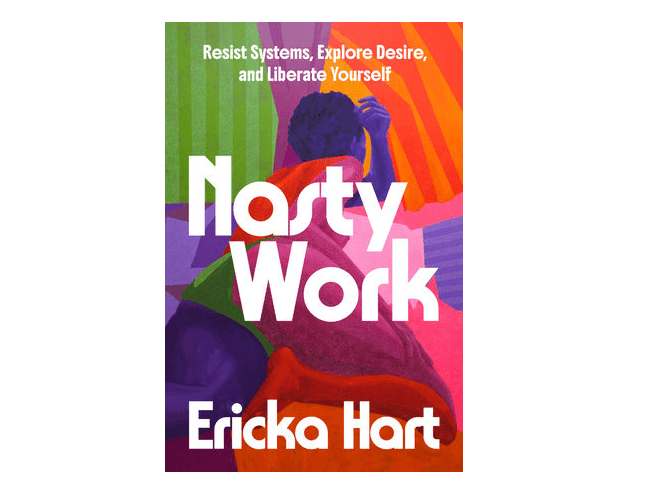
In Hart’s first book "Nasty Work: Resist Systems, Explore Desire, & Liberate Yourself", which comes out on April 14th, she educates readers on the intersection of race and pleasure, breaks down how social implications prevent marginalized communities from experiencing pleasure, and establishes how, despite date sex education material and what we’ve been taught, we can all reclaim pleasure on our own terms. "My work is rooted in how systems of oppression impact your ability to engage in your body and to how you honor other people's bodies," she says. The hyper-sexualization of Black bodies dates back to slavery and a time where Black people were considered savage, unworthy of agency, and ultimately responsible for any sexual violence that happens to us. "So how then does that impact how we see ourselves as Black folks and how we approach desire?," she asks. "When in relationship with Black people and with yourself, how is your body being regarded? Is your consent being honored? Is your bodily autonomy being honored? How is your body regarded in the world and how does that inform how you are in relationship with yourself? Race is 100% connected to desire and I don't think that's talked about enough."
There is an entirely separate conversation to be had, which Hart touches on in her literary debut, about the relationship between pleasure and chronically ill or disabled bodies, a conversation equally as personal to the educator, who is a breast cancer survivor. "We are rendered as asexual non-consensually. People treat folks who are chronically ill or disabled as if we don't have sex at all or that we don't deserve pleasure on our own terms, and also that we can't consent," she says. "So a great deal of sexual violence happens to people living with chronic illnesses and disabilities because of the vulnerable position that we are in. Oftentimes in mental health facilities or even at hospitals engaging with doctors, those doctors take advantage either in an exam or under anesthesia in so many ways. There’s a power dynamic that a lot of chronically ill and disabled folks have to engage with in the world with these systems and that often leaves our bodies susceptible to a great deal of harm.”
We live under myriad oppressive systems that are inherently violent and serve as intentional roadblocks to pleasure. This has resulted in less people having sex in 2026—especially younger generations. "The white supremacist capitalist patriarchy intentionally keeps us from experiencing pleasure on our own terms," Hart says. “The world is a disaster. There’s so much atrocity going on and either you are directly impacted by it or you are experiencing it in some other way. People are stressed. It's a financial crisis right now. People are dealing with money. That will impact your libido. If you can't put food on the table, are you really going to want to orgasm?”
Part of Hart’s mission in writing ‘Nasty Work’ is to explore how we can reclaim desire and pleasure on our own terms. “Look at your inherited beliefs, the things that you've been told about the world, and the things that you've been told about your own body that may be impacting your ability to experience your body on your own terms,” Hart says. On the phone, she shares a story about scientists in Amsterdam conducting a massive study revealing that the clitoris contains so many more nerve pathways than anyone knew (five, to be exact) and that they’re more complex than previously understood, thirty years after the same study was conducted for the penis. "What are you being told about your clitoris, about your body, or about your vulva that maybe you didn't know before because the information wasn't even there?," Hart asks. "You likely weren't even taught it if you were in school in the last 30 years, so how have you been relating to your body without that information?"
While this will likely be a lifelong battle for most of us, it’s important that we work towards disconnecting our sense of self worth to whether or not people desire us. "I think how you look is so fleeting, and the fact that our worthiness would be wrapped up in people desiring us truly shows desirability politics at work," Hart says. "It's the idea that if people are seeing me as attractive, then that means that I'm worthy of life. The fact that we have been conditioned to hold so much focus on other people's eyes, and that other people are determining if we're worthy or not—and people aren't to blame for that because the system has forced us into that."
Additionally, rejecting society’s definition of “normalcy” is key for setting ourselves free—while it’s easy to compare ourselves to other people, there’s no box that we need to fit into and there’s no “right” way of approaching relationships, sex, or general life paths. "Everybody starts to believe that they're supposed to be with a man or woman, get married, have children, work a job and that's just the way it's supposed to be," Hart says. "So much so that people will literally stress themselves out trying to fit themselves into this very narrow idea of who you're supposed to be in a relationship with, and it's just not true. That goes for queer and trans people as well. We do the same thing. We try to fit ourselves into those structures, and it doesn't make any sense. It doesn't work."
Most importantly, we have to be open to learning for the rest of our lives through reading, researching and having conversations like this one. We have to continue to expand our critical thinking skills and to grow more confident in asking questions and articulating opinions. “When I read non-fiction, my brain is expanded and I start making these connections to larger things. I don't think we should just be talking about sex in the sex education work that we do. I think we should be talking about capitalism. I think we should be talking about anti-black racism. I think we should be talking about how our country has a propensity for war and how that's connected to rape culture,” Hart says. “Making these larger connections has always been something I've been interested in. And I think if anybody else is interested in doing that, it just requires a lot of critical thinking.”