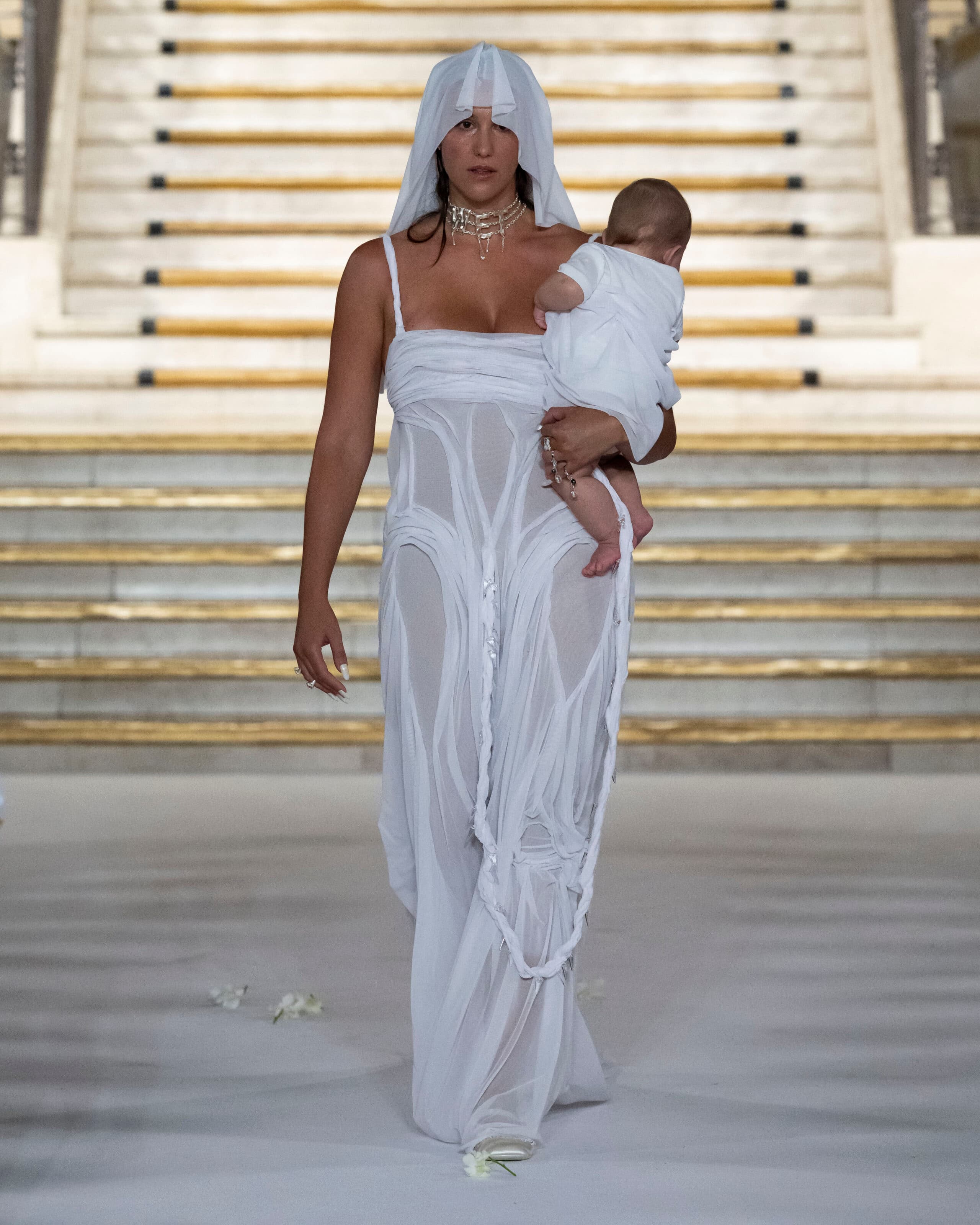
"We're always pregnant with our own self. We're all giving birth to new versions of ourselves all the time," Di Petsa's Dimitra Petsa tells me a few days prior to her Spring/Summer 2027 showing in London this week. The show was titled 'Holy Milk', Di Pesta is a brand that is well associated with the concept of water, wetness, and bodily fluid. This season, the liquid of choice was milk, and the collection unfolded around the life-giving elixir, an ode to motherhood and mothering, the maternal instinct that is instilled upon women, and the tension between the female archetypes that occupy the idea of motherhood.
 Photo: Di Petsa
 Photo: Di Petsa
"I'm at this age now where I see this transition in my friends and my community," she says. "I'm talking about it with these women who have been my muses since the beginning: how motherhood is changing them, and how when you give birth to a child, you're also giving birth to yourself as a mother because it's a completely different identity."
The result was a collection that unpacks the maternal identity, and is central to all of these themes: milk, virginity, mother goddesses, weddings, and so on. White acted as a reference point to many of these ideas. The first exit, a white draped dress in Pesta's signature wet-look style set the tone, followed by a series of white looks—interspersed with deep indigo shades. There were fluid white silk dresses cut on the bias and going-out style tops with the silk string drapery that Petsa has been developing for a few seasons now, a veiled woman wears a white "wet" dress carrying a baby, whose tiny white clothes connect to the mother via a cord that stops in the middle of her torso to symbolize the umbilical cord. "It's all about the last trimester, which is the trimester after we give birth. I have been researching that for years. I think it's just so profound and spiritual and deep. And I just think there is really no conversation in popular culture about it," she says.
 Di Petsa
 Di Petsa
 Di Petsa
 Di Petsa
As the collection evolved, so did the palette. White turned to beige and blue turned to red, scarlet and then wine—almost like a woman's cycle. Evening gowns were intercepted by mini party dresses and gathered two-piece skirts and tops. The final look, worn by a pregnant model, returned to the wet gathered white from the first exit, only this time her breasts began to lactate as she reached the end of the runway, flanked by models in floral and gradient sunset-toned gowns, who kneeled at her feet and let the milk drip onto them. "This is about abundance, nourishment, the mother," Petsa says. "These visuals that come to my head are as much part of the design language of the show as the clothes. Kind of like the accessory to the show." She notes that the element of performance art and how crucial this component is to the Di Petsa brand, which initially started as a performance art concept around water. "It was a declaration that we come from water and that we are wet, that women are wet beings."
For Spring/Summer 2027, Petsa went further. We are not just wet. What we excrete is not always pure, virginal, clean. Rather, messy, complex, nourishing. Fashion, and what surrounds it, often strips women of this fact. It seldom wants us to be more than thin, tidy, contained. Di Petsa carves out space for us to be more.
 Di Petsa
 Di Petsa