“It’s going to become a lot messier before it becomes gorgeous,” professional organizer Briana Bazail warns me, holding a pile of my sweaters before placing them in a pile on the bed. I laugh nervously, eyeing the growing pile of tops, jeans, pants, and jackets that are slowly resembling a miniature mountain. I’ve never felt so exposed
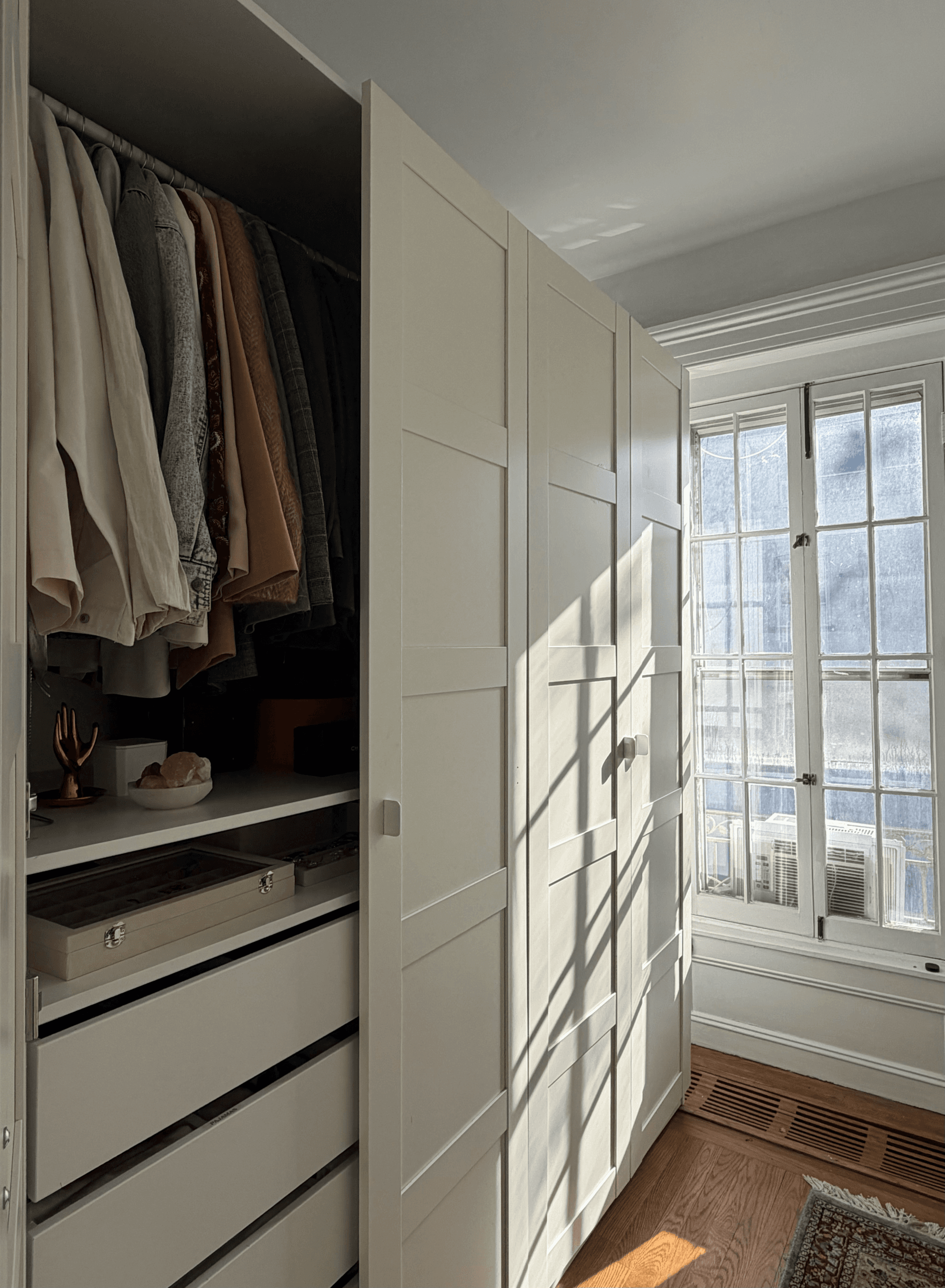
Dealing with the herculean task that is organizing my overflowing closet has been something I’ve put off for longer than I care to admit. But after a move into my dream apartment in New York’s Greenwich Village—complete with a built-in walk-in closet space and a second bedroom that I immediately built out with Ikea Pax units—I knew it was finally time to attempt the organized, aesthetically-pleasing closet of my dreams. But after the Roadway movers swiftly packed up and dropped off my last box of clothes (and assembled my Pax units the next day—bless!), I stared at the empty shelves in panic. How was I supposed to decide where all my clothes (and shoes, and bags) would go? It was time to call on a professional.
Enter: Bazail, otherwise known online as the Reset Brunette, whose organizational prowess far exceeds my own. With a client list of time-starved New York City execs, fashion influencers and Greenwich moms with jaw-dropping Birkin collections, I knew Bazail was more than capable of the task. (She’s also kind and non-judgmental—two important traits you want from someone who’s seeing everything you’ve shoved into the deepest darkest corners of your closet.)
Two full days later, I stared into the perfectly-organized closet of my dreams. Every drawer had a purpose, every sweater was folded with military-like precision, and, most importantly, I knew exactly where every top, sock and shoe was. Call it the Marie Kondo effect, but having a well-organized closet has not only helped me get dressed easier in the morning, but also freed up my mental clutter. I’d even go as far to say that my style has improved, because I know exactly where to reach when I want to add an extra layer, or a pop of color. Last week, I came back from a trip and actually did the unthinkable: I unpacked immediately. As someone who usually leaves their suitcase in the hallway for at least a week before begrudgingly unpacking, this felt like proof that the closet refresh has indeed changed me on a visceral level.
Along our two-day journey together, Bazail shared some life-changing tips on closet organization that I’m still using to this day—I’m sharing them with you below.
1. Edit Your Closet
 7 Closet Organization Tips That Changed How I Get Dressed Faith Xue
If there's one thing Bazail drilled into me over our two days together, it's that an organized closet is a constantly evolving one. Before we even touched a hanger, she had me confront the hard truth: I had been accumulating clothes (and shoes, and bags) without auditing for years. "The biggest mistake I see is not editing your wardrobe consistently," she says. "If you love fashion, you naturally love adding to your closet. But without regular edits, things very quickly become overwhelming." Her recommendation? A wardrobe “edit” every three to six months. "When you don't, you end up in this cycle where you're constantly bringing in new pieces, forgetting what you already own, and ultimately not wearing the items you actually love."
Since my closet reset, I’ve been holding myself to the one in, one out rule: every time I buy a new item of clothing, I put one item in my donation pile. So far, it’s holding me accountable.
#2: Remove, Refine, Reset
Bazail's signature process, which she calls the Reset Method, is the backbone of everything she does. "Before you organize anything, you have to understand what you actually have and whether it makes sense for your life," she explained, as I watched my entire wardrobe migrate to my bed. Her method moves through three stages: remove, refine, and reset.
First, everything comes out of your closet—the messy part. She recommends sorting those pieces into five categories: keep, sell, donate, trash, and maybe. "It helps turn what can feel overwhelming into something much more clear and manageable," she said—and honestly, having a "maybe" pile was a game-changer for my indecisive brain.
Tip #3: Deal With Your "Maybes"
Deciding whether to keep or get rid of your “maybes” can be hard for some people who are emotionally attached to their things (me), or are the type to hold onto things they never wear “just in case” (also me). If you relate, try this: split everything you’re unsure about into everyday essentials, occasion pieces, and passed-over pieces. For everyday essentials, toss or donate anything that feels overly worn; keep the rest. For occasion pieces, be honest with yourself about how wearing each item makes you feel. Lastly, for passed-over pieces—the top you never seem to reach for, the shoes you tell yourself you’ll wear, but never do—be honest with yourself about the reason you never wear them. “I’m less interested in when you last wore something and more in why you didn’t choose it,” Bazail says. “If you keep skipping over it, there’s usually a reason, and it likely doesn’t fit your life the way it used to.” In other words: let it go.
Tip #4: Organize By Wear
From there, the refining stage is where you start to make decisions about how your closet actually functions day-to-day. Think about what you reach for constantly versus what's purely seasonal. "That naturally determines what deserves to be front and center, versus what can be stored a bit further out of reach," Bazail says.
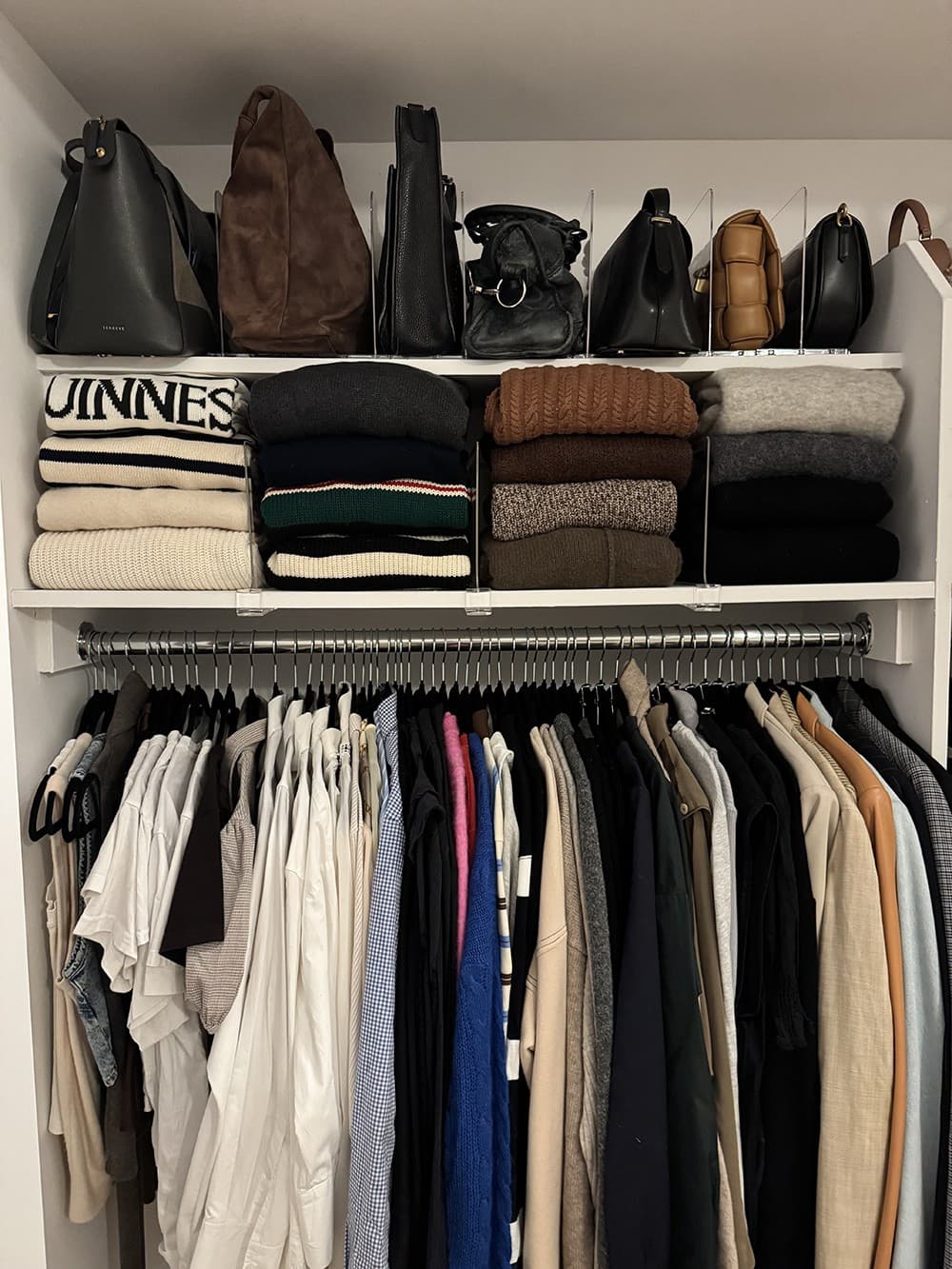
For my closet, she hung my blouses and tops above my pants and skirts; these are my everyday items, so she put them front and center. My blazers and light jackets were hung in the next room, and my winter coats were hung in a different unit entirely—so, come summer, I can ignore that area completely. "The goal isn't just for it to look good, but for it to function in a way that actually lasts,” she says.
Tip #5: Invest In Organizers
 Faith Xue
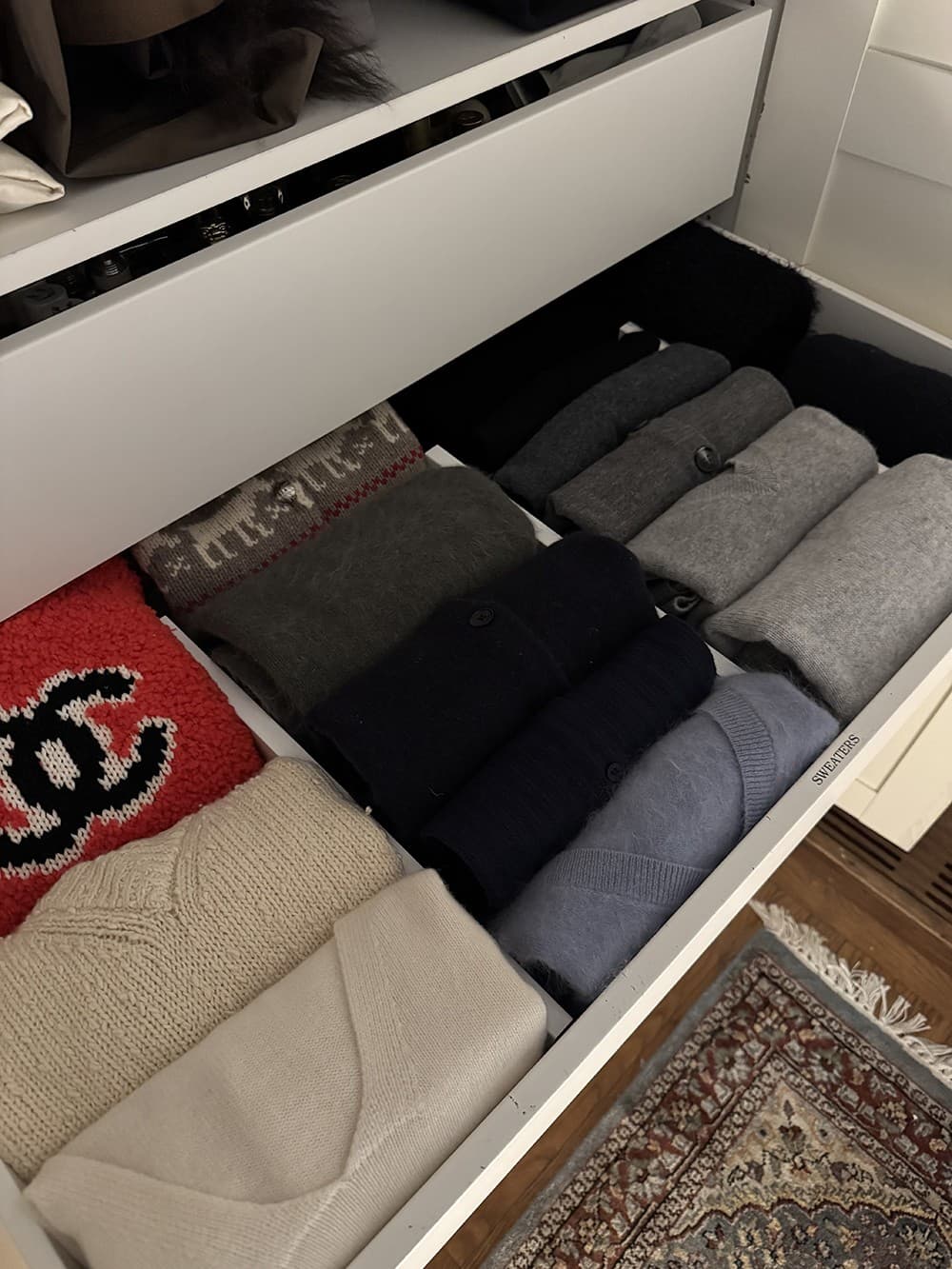
"The most chic spaces are actually the simplest," she told me. "It's less about adding more and more organizers, and more about creating a sense of uniformity." Her go-to upgrades? Matching thin felt hangers (which look chic and help save on space), consistent bins, and simple drawer dividers. "Those subtle upgrades instantly make a space feel more elevated and intentional."
Now that I’ve been living with my new closet for a few weeks, two things that have made the biggest difference are the drawer dividers and the bins. The drawer dividers allowed me to break up my larger drawers into different sections and give me more space—the key is to fold your tops and place them in vertically, like papers in a filing cabinet—while the bins are perfect for throwing things into when I’m short on time but don’t want to look at clutter.
But she was firm on one key point: "Too many organizers can actually make a space feel more cluttered, not less." When it comes to specifics, her foundational list is short: felt hangers, clipped hangers, pant hangers, drawer dividers, set hooks, a hat organizer, a sunglasses organizer, and a jewelry display.
Bazail recommends the below organizers:
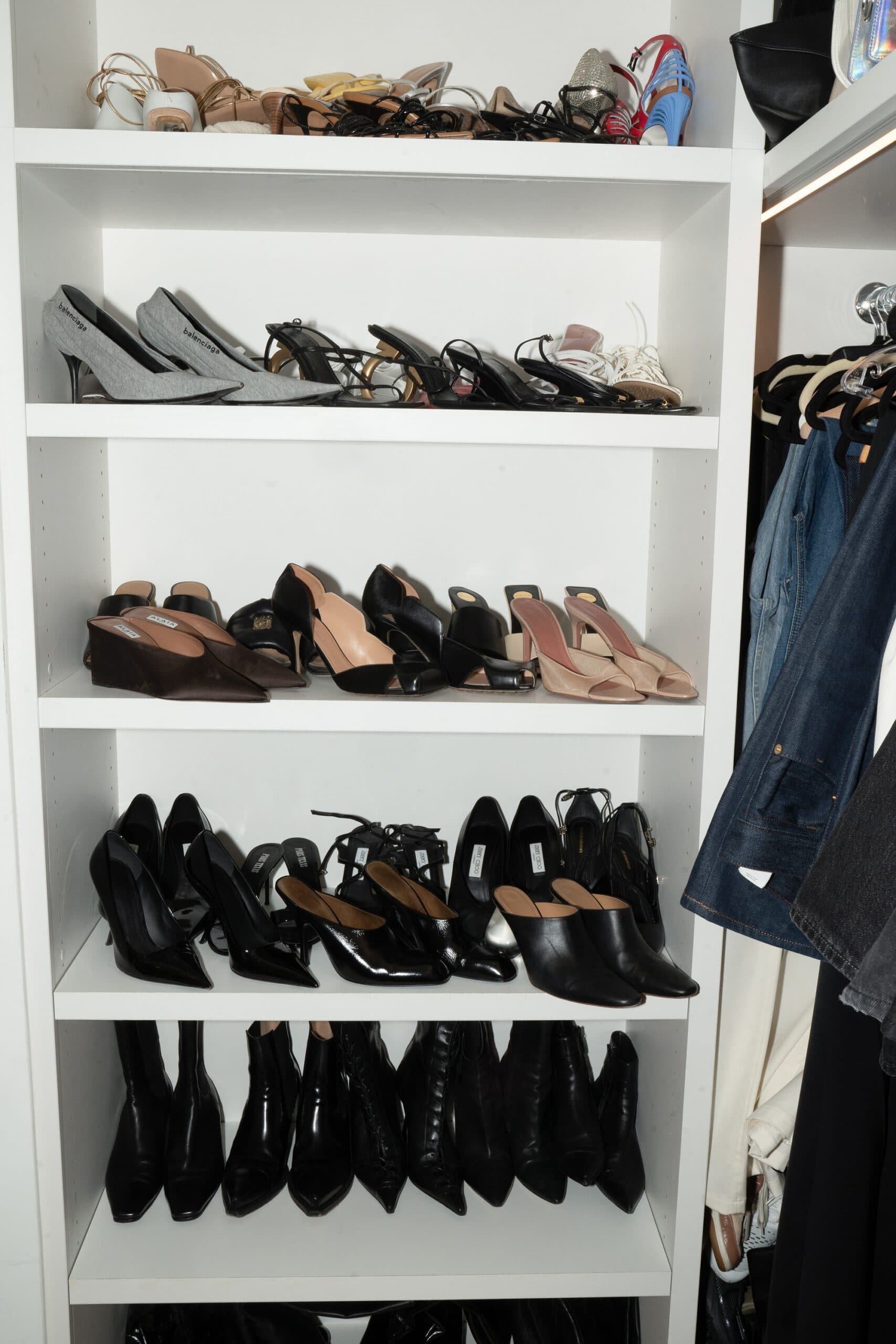
Tip #6: Stack Your Shoes & Hang Your Bottoms
 Faith Xue
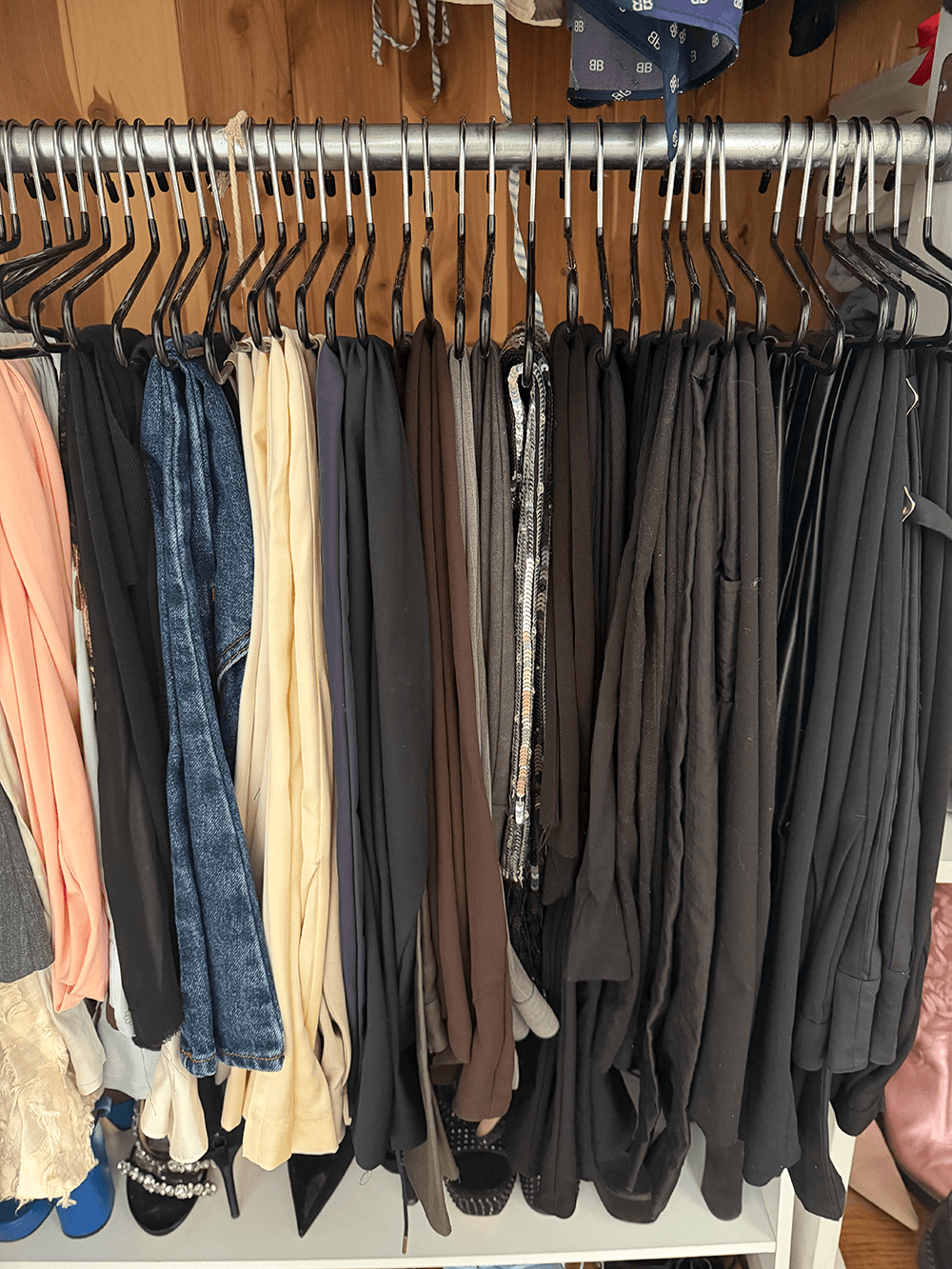
Shoes and bottoms are two particular things I have in excess. I was concerned there wouldn’t be enough room for them, but Bazail proved me wrong with a few key tricks. For shoes, Bazail is a firm believer in going vertical. "Shoe stackers are great because they instantly double your storage without taking up more room," she explained, as we transformed what had been a ground-level shoe pile into a tidy, stacked display. For pants, instead of clipping them or folding, she flipped them over these non-slip hangers. Not only does it look satisfyingly organized, but it also gives you full visibility of every bottom you own.
Tip #7: Stick With A 20-Minute Refresh
In the end, "it's never about perfection, it's about function and consistency," Bazail told me. "A well-organized closet shouldn't feel rigid or high-maintenance." Her prescription for the time-strapped: a monthly refresh of just 20 to 30 minutes. "Pull anything you're not wearing or loving, straighten what's gotten out of place, and make sure everything is visible and accessible," she said. "It's really about small, consistent check-ins rather than waiting until things feel overwhelming."
For a full reset, she recommends every 3-6 months—especially if, like me, you have a habit of adding new pieces regularly. "Regular resets help keep everything feeling manageable and intentional."
Since my full rest, I've kept up with it. Instead of a monthly refresh, I’ve been holding myself to a weekly one (a necessity, given the amount of products and deliveries I get). The most surprising part is that I find myself enjoying the ritual and satisfaction of putting my things away. Everything has its designated spot. No more shoving things into corners, knowing I’ll soon forget them. Bazail was right—it did get messier before it got gorgeous. But now that it's gorgeous, I’m not going back.