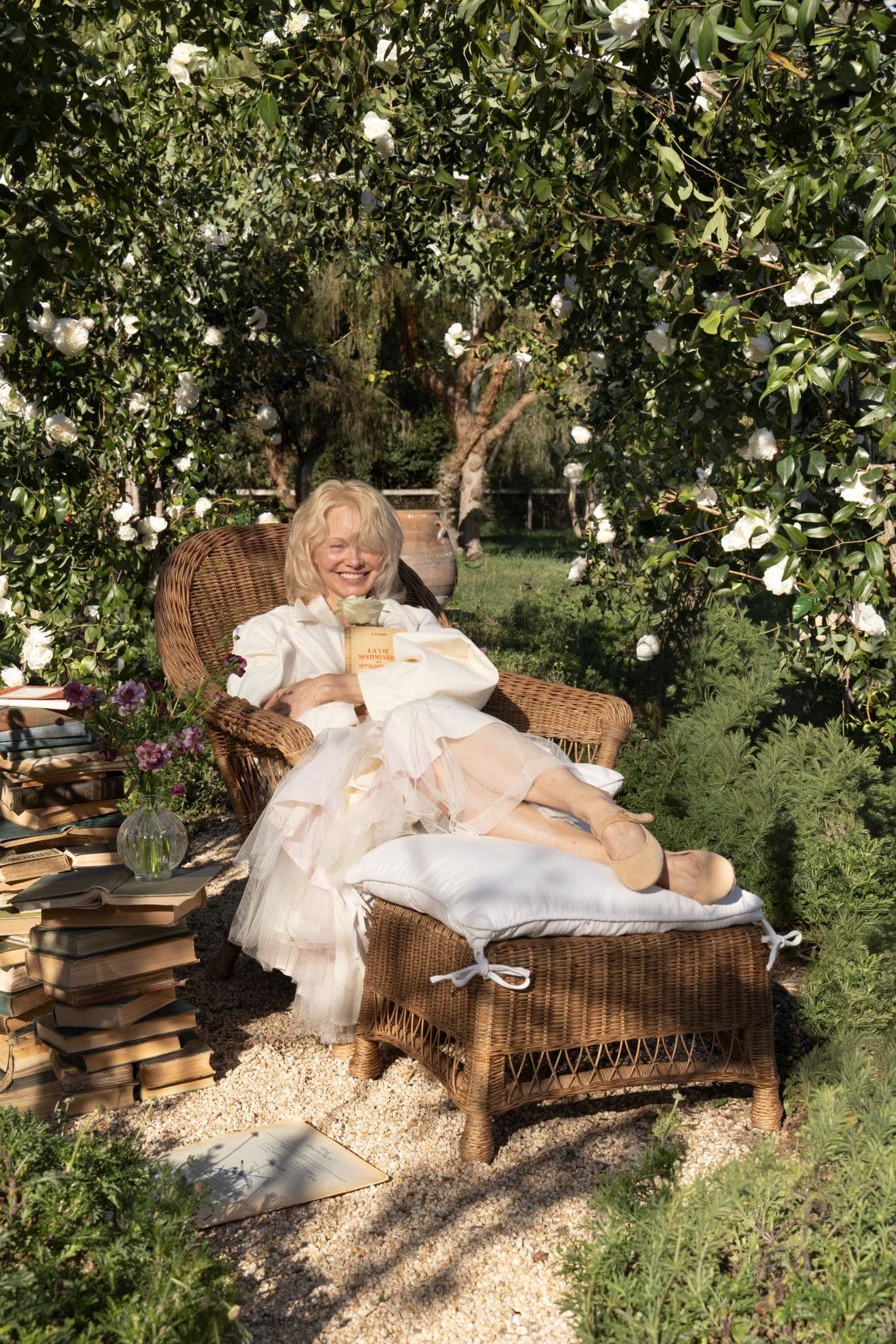
For decades, the masses have been bombarded with celebrity product endorsements. It usually starts with said celebrity first becoming a brand ambassador, collaborating on a product, and eventually hard launching a brand of their own making. Let the record show that some celebs are doing it better than others—see Gwyneth Paltrow’s goop, Rihanna’s Fenty, Mary-Kate and Ashley Olsen’s The Row, and Hailey Bieber’s Rhode. While brand universes have always been spurred by buzzy partnerships, we’re quietly moving away from celebrity for celebrity’s sake and toward collaborations that are rooted in a real sense of perspective.
It wasn’t long ago that beauty brands were the ultimate celebrity credibility play. Today, the status marker is something much harder to fake: taste. And increasingly, celebrities are trying to prove that they have it through furniture collections, home collaborations, and design partnerships. (Do you really need convincing about Julio Torres having an eye for design when you’ve already seen how he pushes boundaries inside his Williamsburg loft?) Unlike a tube of lipstick or an It Girl bag, a piece of furniture implies more permanence, both because of its size and also price. A couch isn’t an impulse purchase; it’s a status symbol that reflects how you want to live.
 “Emma has this incredible ability to make design feel approachable,” says Keith Pollock, SVP of Creative at West Elm. “Her world is elevated, but never intimidating. That balance made her an incredibly compelling partner for us.” Photo: West Elm
For me, appeal is less about the person and more about the product. (In this house, nothing will ever top the Kacey Musgraves x Boy Smells “Slow Burn” candle!) The only time I ever felt a jolt of excitement about a collaboration was in 2018 when IKEA announced a forthcoming collection with Saint Heron that has yet to see the light of day. As a millennial, graduating from a dorm room to a studio apartment was a huge shift. Although my spending power was very limited in 2015, I made the most out of outlets and sale sections to furnish my home. As a 22-year-old, I wouldn’t have been able to afford what would eventually become my breakup couch—a blush pink velvet settee from West Elm discounted to $500—without my parents offering to cover half.
Unlike the highly curated homes that consume our Instagram feeds today, my first apartment looked like a Tumblr collage. So, when Gen Z influencer, podcaster, and coffee connoisseur Emma Chamberlain welcomed Architectural Digest into her Los Angeles home, I was impressed. At the time, the then-21-year-old prioritized comfort over everything, a quality that deeply resonated with a much wider and younger audience than the average AD reader, and hired Proem Studio to fine-tune her laidback design sensibilities. (The accompanying “Open Door” video has racked up 13 million views since it was uploaded in 2022.)
The Emma Effect
Back in March, Chamberlain shocked her 14.1 million followers on Instagram once more by dropping a furniture collection with West Elm. Instead of churning out Hollywood cosigns from A-listers, West Elm targeted content creators like Timarie Maxwell, Mada Graviet, Connie Korenovsky, Peyton Dix, Abby Jardine, and Maya Taki for partnerships to promote products from the line. Keith Pollock, West Elm’s SVP of Creative, claims that the brand wasn’t targeting a specific demographic, but “designing around a mindset and new generation of consumers who are just beginning to create their homes.”
Since leaving AD for West Elm in 2020, Pollock’s strategy for collaborations has relied on seeking out creatives with a strong visual identity and distinct voice, a special combo that offers a perspective that feels lived-in and personal. (This list includes Pierce & Ward, Billy Cotton, and Eva Chen.) Beyond her massive social following, Chamberlain was an ideal collaborator because of her approachable aesthetic awareness. “For West Elm, it’s not just aesthetics, but genuine design interest and curiosity,” he explains. “What drew us to Emma was that her aesthetic feels deeply personal and emotionally grounded. Nothing about her taste feels manufactured.”
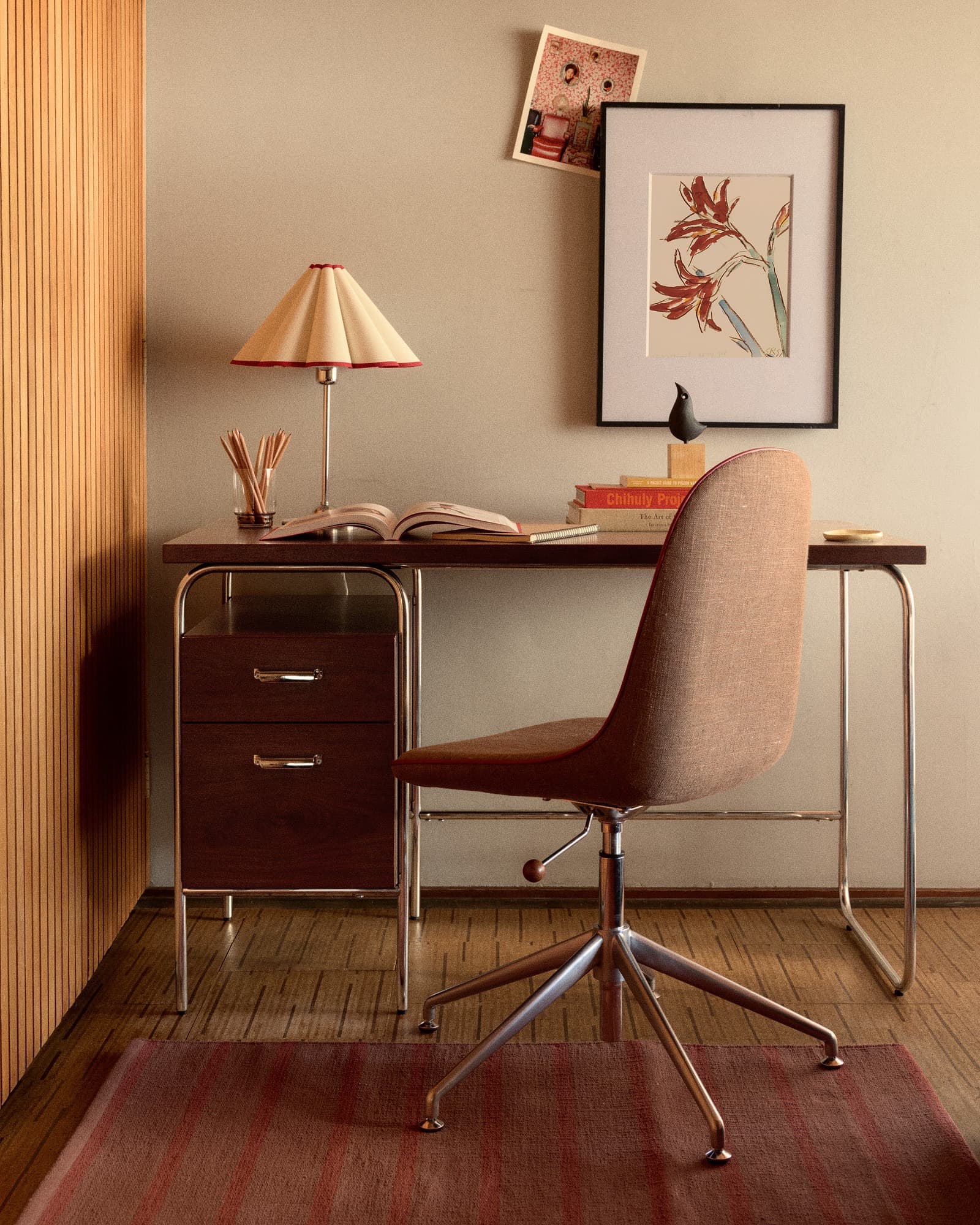 “Emma has built trust with her audience because she shares herself honestly and we wanted the campaign to reflect her sensibility without losing our brand voice,” Pollock says. “She wanted people to sit on the couch, spill something, and to actually live in the space.” Photo: West Elm
Apparently, the 25-year-old was adamant about not making anyone’s home feel “untouchable or overly curated.” The result is a playful collection of 100+ items that Pollock describes as “expressive, a little unexpected, but still highly functional.” Although Chamberlain’s line pulls inspiration from the midcentury-modern and ’70s funk, it also reminds us that design doesn’t have to be so serious through objects like ceramic pigeons, burl wood buttons, and apple baskets. (Some of these motifs were inspired by her tiny tattoos.) Drenched in a muted palette, there’s no dopamine induced kindercore or sad beige moms in sight.
“Emma came into the process with highly developed ideas, detailed mood boards, and clear creative references, many of them drawn directly from her own life,” he says. “She worked closely with our in-house design team over nearly two years, bringing her personal perspective to every stage of the process and collaborating through countless iterations to shape the collection.”
 A not-so-subtle product placement for Chamberlain Coffee. Photo: West Elm
From Customer To Collaborator
A month later, Pamela Anderson entered the chat with a furniture collection for Olive Ateliers called The Sentimentalist, marking the first-ever design collaboration for the Los Angeles-based brand founded by Kendall Knox, Ben Knox, and Laura Sotelo. Despite the makeup-free model and actor experiencing a major renaissance with her return to the screen and the stage, this particular collaboration occurred organically—she and her sons have been customers since Olive Ateliers opened a Los Angeles showroom in 2023.
As ideation for the third Olive Ateliers collection began to take shape with rattan and teak at the center, the team was immediately reminded of Anderson’s style. “We reached out to her and said, ‘Hey, we’re thinking that this is the direction that we’d like to take with this collection. Would you like to come on board and do it with us?’ It was honestly the easiest conversation and partnership I’ve really maybe ever fallen into,” Knox recalls. “We had a really strong vision, all of us, of what we wanted to create, and the process was really fun and easy.”
The collaborative process began with Anderson sharing the items she regularly uses at home like “the basket she carries when she cuts flowers, a different one for vegetables, and another for stacking wood by the fire, and the armchair on her porch.” As for the fabrics, Anderson sent images of vintage ticking stripes that she’s collected over the years. There were also “long conversations about weight and wear and what a piece will be like to live with in ten years.” From this perspective, Oliver Ateliers literally designed every piece around Anderson’s real life rather than inventing one for her to endorse.
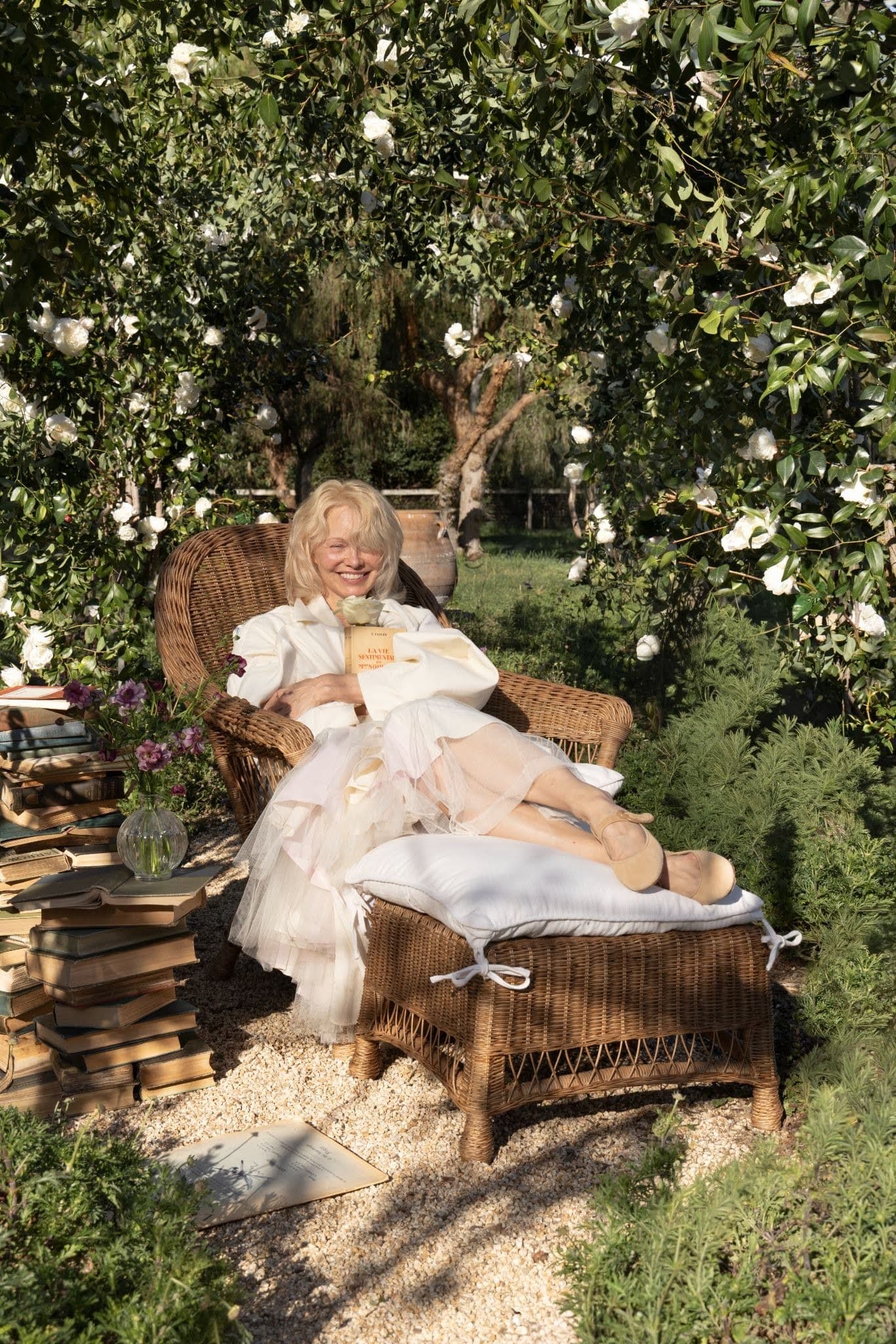 Kendall Knox, Chief Brand Officer of Olive Ateliers, remembers how surprised she was to find out that Anderson was a huge antiques collector. “I really felt like we shared a sensibility of taste,” she says. Photo: Paige Powell
Knox insists that it was “less about how a thing looked and more about how it felt, like the way a cushion responds when you sit down on it, or whether the weave softens or resists.” Anderson was particularly excited about the rattan furniture from the tint, color, and finish to “where the hand of the maker should be allowed to show.” They were also very aligned on using materials that would age rather than degrade. “It mattered to her that nothing be too perfect,” she adds.
With a focus on timelessness over trendiness, Olive Ateliers is motivated to partner with people who are “iconic in every era.” Since officially launching the brand in 2021, the most important goal has been establishing themselves as design authorities within the industry at large. Instead of doing a random celebrity edit or capsule, the team preferred to wait for the right opportunity to come along.
“It’s very easy to tap a celebrity and put their name on something,” Knox says. “This really had to stem from a shared sensibility of taste, and then us really looking at [Anderon’s] rituals, figuring out how she lives her life, and how we can make sure we’re designing products that reflect and work alongside that.”
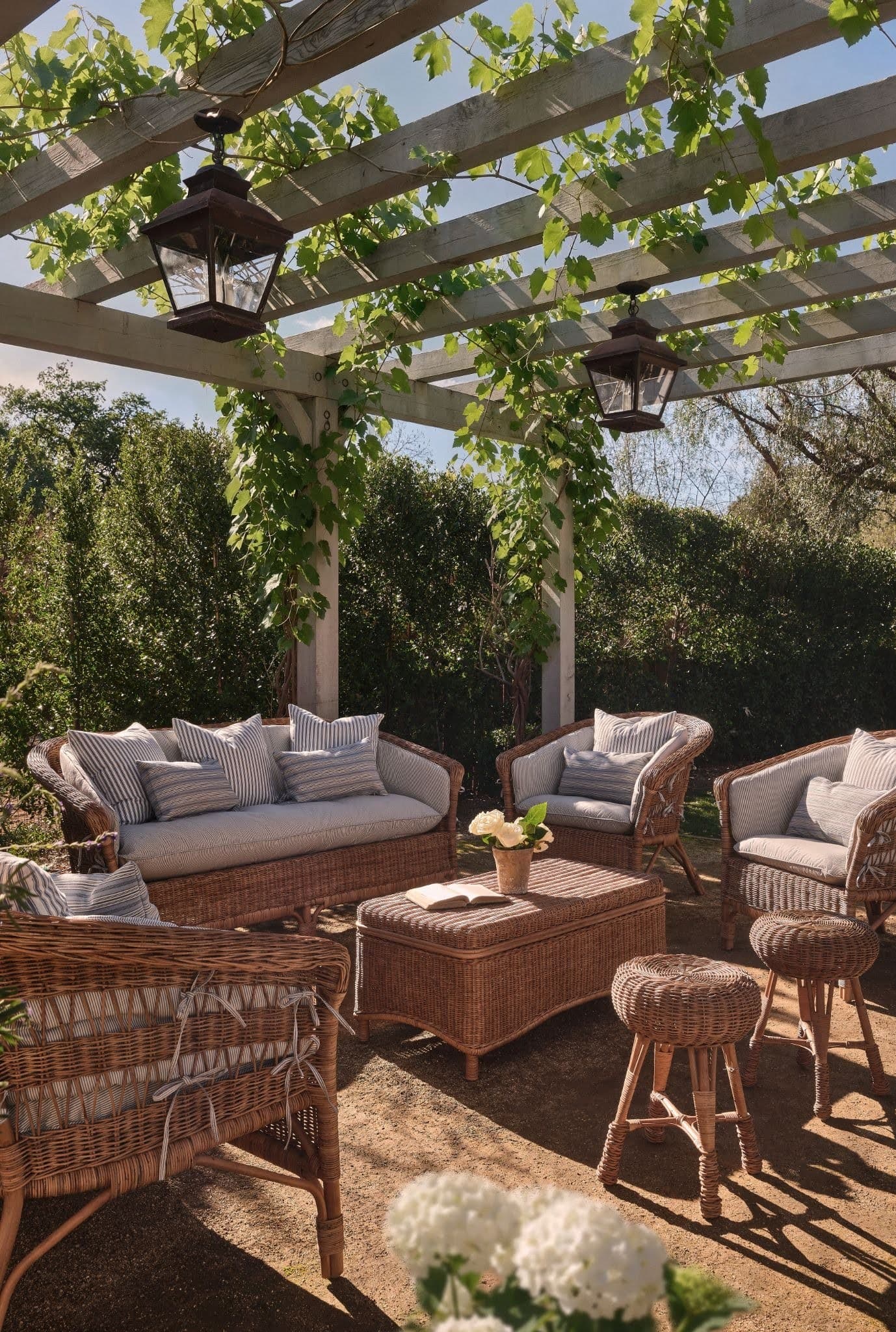 “For us it’s less about whether it’s a celebrity and more about whether that person, famous or not, shares the lifestyle,” Knox says. Photo: Michael P. Clifford
The Power Of A Dialed-In Duo
When the actor Laura Harrier casually slid into Tiffany Howell’s DMs about designing her next home back in 2019, neither of them could have anticipated that it would lead to creating a Crate & Barrel collection someday. (More than just an interior designer, Howell actually helped Harrier find her house in the Hollywood Hills that they would go on to flip into a millennial pink paradise.) While Howell is used to developing deeper connections with clients of Night Palm, this marks the first time that she has ever expanded that collaborative relationship into a collection with a major retailer.
“These worlds that we create together, we really enjoy living in them,” Howell explains. “It’s not just the furniture and the lighting—we were both really interested in creating an atmosphere. That, to me, is what’s important. We literally considered everything in a room and how it’s all interconnected—we really wanted to create these beautiful, atmospheric moments for people.”
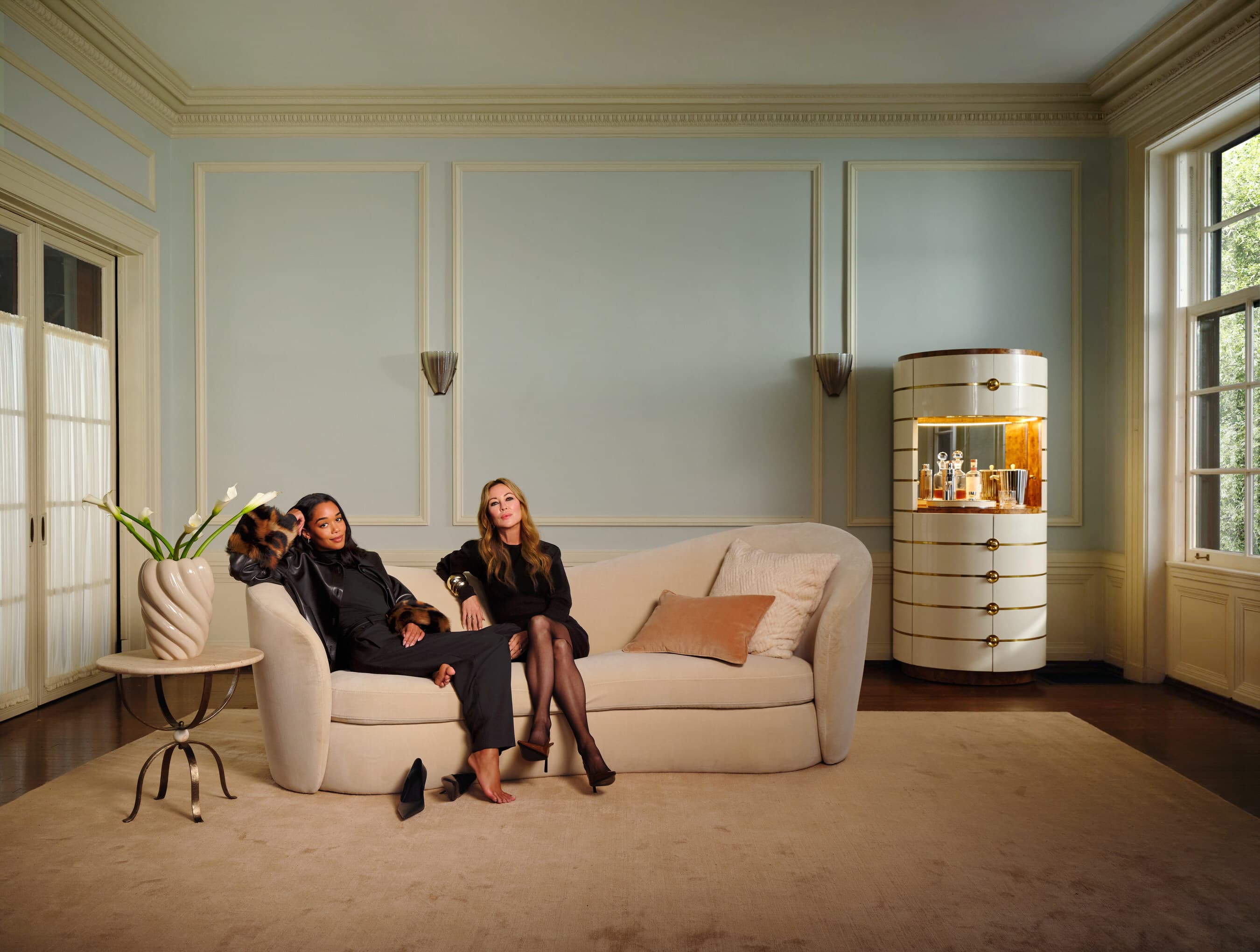
“You develop this design love language with each other where you’re able to really communicate—you have similar moods even though you’re bringing a different perspective,” Tiffany Howell says. “Once that aligns, I feel like it just always works.” Photo: Crate & Barrel
When a celebrity pivots into design, we rarely see them share the spotlight with their designer—most of the time, they’re not even properly credited for their work in the home. (In comparison, goop has collaborated with CB2 twice, but Gwyneth Paltrow’s interior designer Brigette Romanek didn’t get a Crate & Barrel collection until last year.)
“It just seemed like the obvious choice to do it together,” Harrier says. “It’s such a pivot to what I normally do so I’m excited to show that part of myself. All of my friends will tell you how obsessed I am with design, I’m so psycho about my house every time people come over, but why would people know that publicly? It’s a cool new thing to explore.”
Harrier and Howell are both fluent in the art of collaborations—the actor teamed up with Reformation in 2024 while the interior designer conceived a sexy sofa with Ellison Studios in 2025. The motivation to work on a collection together stemmed from their shared interests and creative alignment. “For me, it came from a place of ‘What do I want to make? What do I want to put out in the world? What am I passionate about?’ I was looking around a lot of my friends and peers, and it feels like everyone is doing beauty or skincare,” Harrier continues. “It just got me thinking, ‘What do I really love? Design and furniture and everything home related.’”
 “We had done so many custom pieces for my home over the years and that was always something that I really loved the process of” Laura Harrier says. Photo: Crate & Barrel
Howell was very hands-on from concept through development, working closely with Crate & Barrel’s design team to “shape each piece from its earliest stages, building mood boards, selecting Pantone colors, developing finishes, and obsessing over the details until everything felt just right” over the course of two years. “Once we reached key milestones, I would bring the work to Laura, whose perspective helped further refine the collection,” she adds. “It was a truly collaborative process, but I was intimately involved in every stage of translating the initial vision into the final pieces.”
They approached the collection as a series of individual pieces that build out a world “with its own atmosphere, references, and emotional language.” The result is Howell x Harrier for Crate & Barrel, an 87-piece collection tailored to Howell and Harrier’s combined tastes (’70s glamour meets Old Hollywood elegance) with details dialed into some of their favorite pastimes. Howell pulled references from vintage fashion and jewelry campaigns—think Alaïa corset belts, Elsa Peretti cuffs and bangles, and Calvin Klein minimalism. “I keep calling this collection soft glamour in a sense because it’s glamour, but it feels grounded and accessible,” Howell says.
Harrier points out how the bottom cabinets of the burl wood and gloss lacquer bar were specifically sized for the records they love spinning; the stainless steel serveware and fluted glassware mirrors their passion for hospitality. (On release day, they hosted a star-studded launch party at Chateau Marmont.) “It really speaks to our aesthetic, but also lifestyle,” she adds.
Who Has The Best-Selling Influence?
In 2026, is it more valuable to be a tastemaker or an influencer? In the case of Athena Calderone, you get both. After years of recommending products on her EyeSwoon platform, the lifestyle influencer turned her eye for design to Crate & Barrel and Beni Rugs, creating a sophisticated series of Art Deco-inspired collections that look like a moodboard for her infamous Tribeca loft. While most mainstream retailers follow the traditional model of partnering with interior designers, brands like Lulu and Georgia stand out by working with a roster that includes Sarah Sherman Samuel, Jake Arnold, Heidi Caillier, Aimee Song, Eny Lee Parker, and Carly Cushnie.
So, do celebrity-fronted collections actually translate in the design space? While we’ll never really know if there’s higher ROI when a brand taps a celebrity or a celebrity designer, what really stands out is the person who has a distinct point of view. Howell emphasizes that the home space offers more intimacy compared to the beauty world. “A beauty product is deeply personal, but its relationship is primarily with the individual,” she explains. “Furniture has a relationship with a life. It quietly becomes part of the emotional architecture of a home and the memories created within it.”
At the end of the day, the growing intersection of celebrity and design is mostly a positive shift that indicates a collective desire for knowledge. If learning how to build a real point of view is wrong, lock me up and throw away the key! Furniture remains the ultimate marker of taste, but I anticipate this new era of collaboration unlocking access to a more attainable space where good design isn’t so far out of reach.