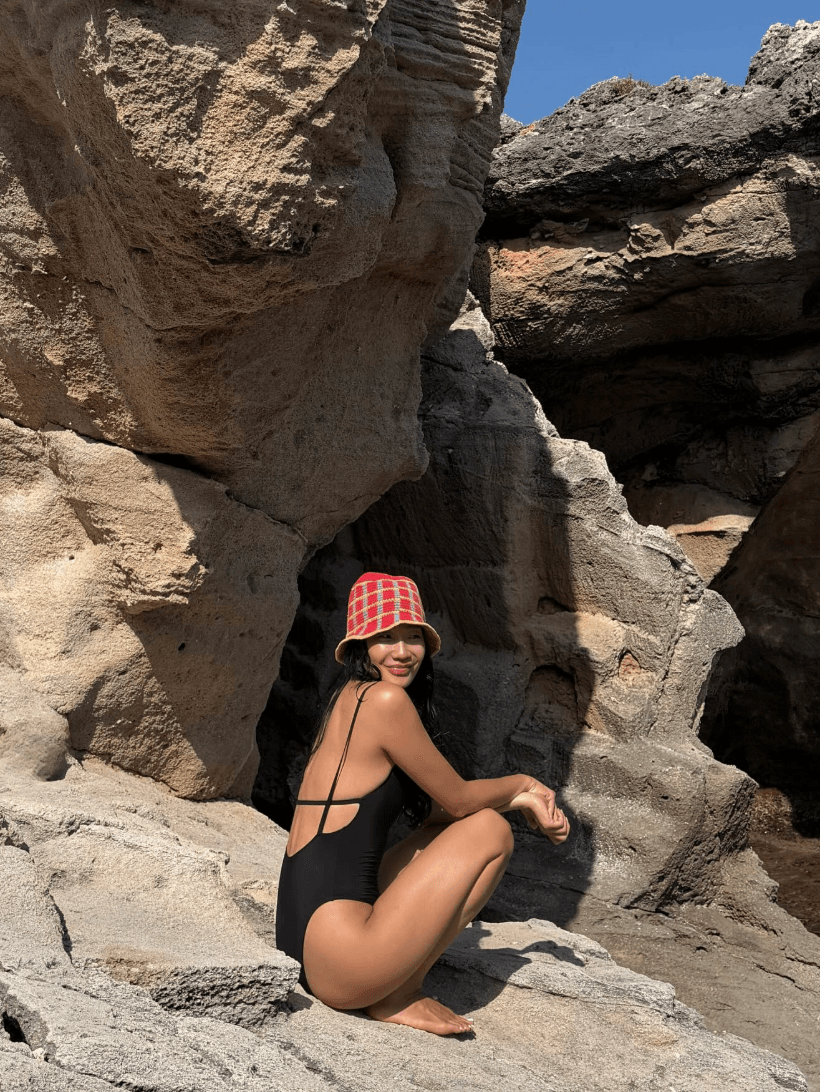
After completing all the errands (hello, Appointment Olympics), packing all the outfits, and planning the itinerary, you finally made it to your dreamy destination. Now all that’s left to do is sit back, relax, and enjoy your hard-earned vacation. But what’s a beachside cocktail without a scenic Instagram story to show off the moment? Or a Euro summer getaway with no photodump? As much as we try to unplug during our travels, social media has a way of keeping us on-call, no matter how much time we take off. In the words of the age-old saying: Pics or it didn’t happen.
Documenting our vacation through photos and video is nothing new, but what was once recorded with a grainy camcorder and reserved for family photo albums is now captured on our iPhones, destined to be shared on social media. Instagram, TikTok, and even Substack have become platforms to highlight the best of the best in our lives, with a vacation offering a top-tier opportunity to flex.
According to Rachel Goldman, PhD, a licensed psychologist and clinical assistant professor at the NYU Grossman School of Medicine, the urge to present our vacations stems from a behavioral pattern that can be traced back to the Stone Age.
“Years and years ago, when our ancestors were hunting and gathering for food, if you saw somebody else with a certain tool or a weapon, the reaction is, ‘They're going to get the food that I can't get because they have the better weapon,’” says Dr. Goldman. “So if we think about it that way, our brains are wired to compare for survival. Comparing is not a bad thing, but the world that we're living in today, the threats are not the same. Today's modern-day threats are, who has the better job or who has the better social media.”
Dr. Goldman also points to the rise of celebrity and influencer culture, which has skewed our perception of what an online presence should look like. “Years ago, we were using social media like a photo album. It’s evolved to a curation of beautiful pictures,” she says. “You have to find the perfect restaurant, the perfect outfit, the perfect all these things. There's so much more pressure.”
How Social Media Impacts The Planning Process
Whether you're going on a solo trip, a couples getaway, or a trip with your girlfriends, the lead-up to the vacation can require lots of work—especially if creating (and posting) content is top of mind. “We've planned out the restaurants, excursions, beach days, and discussed whether we want a private chef some mornings or nights, which day we just wanna explore, all of it” says Christina Pagan, a practice manager at Hudson Dermatology and Laser Surgery, who is visiting Saint Martin with friends in August. “Outfits are a big part of the prep, too—I already have a few shopping carts going. I like to have everything from the shoes to the accessories all figured out.”
Pagan admits “a lot of planning” can make the urge to document it all even greater: “I used to be the person taking pictures of absolutely everything, from the airport to the plane. Now, I'll take some photos and videos here and there, and create a photo dump afterwards, because that's a thing now.”
The Photo Dump
A collection of snapshots from your trip (belovingly called the photo dump) has become one of the most popular methods for vacation-sharing. Although these roundups are meant to feel random and spontaneous, curating the images can be rather time-consuming and methodical.
“You always want a good mix in a photo dump,” says Laura Jung, a content creator and author of the lifestyle Subtack Digestifs. “You want an outfit photo, a selfie, something a little cheeky, some food, a vibe shot. You want to include friends to not seem like you're there alone—you need the perfect balance of all the elements that make your vacation look beautiful and enjoyable.”
Jung, who recently traveled to Italy, Turkey, and Mexico, admits the curation process usually takes “way longer than it should.” With the favorites tool, she’s able to narrow down the shots in an hour and change. “It seems like a long time,” Jung explains. “But then I talk to a lot of creator friends, and they're like ‘it takes me a full day to edit a photo,’ and it reminds me that I’m not alone.”
David Evan Ruff, a New York-based editor and content creator, will spend a few minutes at each location taking “as many photos and videos as possible.” During his solo travels, he’ll bring along a tripod, but when traveling with family and friends he’ll enlist their help. “It's better to have a higher volume of content that you can just take naturally and casually and then edit and delineate,” Ruff says.
Ruff, who recently returned from a voyage to Japan, says a photodump can take him anywhere from 10 minutes to half an hour. To streamline the process, he organizes his content into albums. “I don't necessarily plan a shot list or outfits that I want to capture, but I have some ideas in the back of my head.”
Though social media is their livelihood, both Jung and Ruff make a conscious effort to be present and consider their travel companions. Jung starts her vacations by setting an intention: “I always want to leave feeling like ‘I really fucking enjoyed that,’” she says, “I’ve left wondering if I could’ve been more present. That feeling sucks.”
So What Can We Do About It?
Whether you’re traveling or not, setting boundaries with your phone is always important. “I try to give myself at least two days when I'm off my phone when I'm on vacation,” says Ruff. “It’s a goal and it doesn’t always happen.” To fight temptation, Ruff will sometimes abandon it altogether. “Being in a location where there's a beach or a pool makes it so much easier to put your phone in your room and not go near it,” adds Ruff. “It's more important for me to be present in the moment than to get the perfect shot.”
Switching up devices can also be helpful. Ruff has started bringing a disposable camera, which feels much more low-stakes due to its simple nature. “I have loved taking a disposable, especially when I'm traveling with friends because we're taking photos very casually and it has a limited amount of shots,” Ruff says. “We're more intentional with what we're taking pictures of, and we can't see the photos until they're developed.”
At the end of the day, it should be about how your vacation feels—not how it looks. If you find yourself constantly stressing about getting the right photo, Dr. Goldman says it might be worth reevaluating your relationship with social media.
“Ask yourself: ‘How do I see social media fitting into this vacation? Why am I posting this?’,” she says. “ Be intentional about when and how you're gonna post and then take a break. Balance is so important, and everybody's balance can look a little bit different.”
Overthinking also isn’t guaranteed to produce a better photo. Both Jung and Ruff’ say some of their top-performing content has come from moments with the least amount of production. During a recent trip to Italy, Ruff and his friends decided to take some pictures in the living room of their Airbnb. “It was super quick, maybe two minutes. Didn't shower, didn't change,” says Ruff. “It ended up popping off and getting 40,000 likes, as opposed to something I put more time and effort into.”
The irony here is no coincidence. We don’t need an algorithm to tell us that honesty resonates with people. “Psychologically, we're more natural when we’re taking photos on the fly,” says Dr. Goldman. “You're gonna feel more authentic and more genuine because you're being your natural self, as opposed to the perfect this or the perfect that.”
To put things in simpler terms: “It’s never really that serious,” says Jung. “I really do believe at the end of the day, what makes our memories sacred to us and what will help us remember these trips is photos and video. But whether it's a good photo or a bad photo doesn't really matter in the long run. What actually matters is the fact you have the memory at all.”