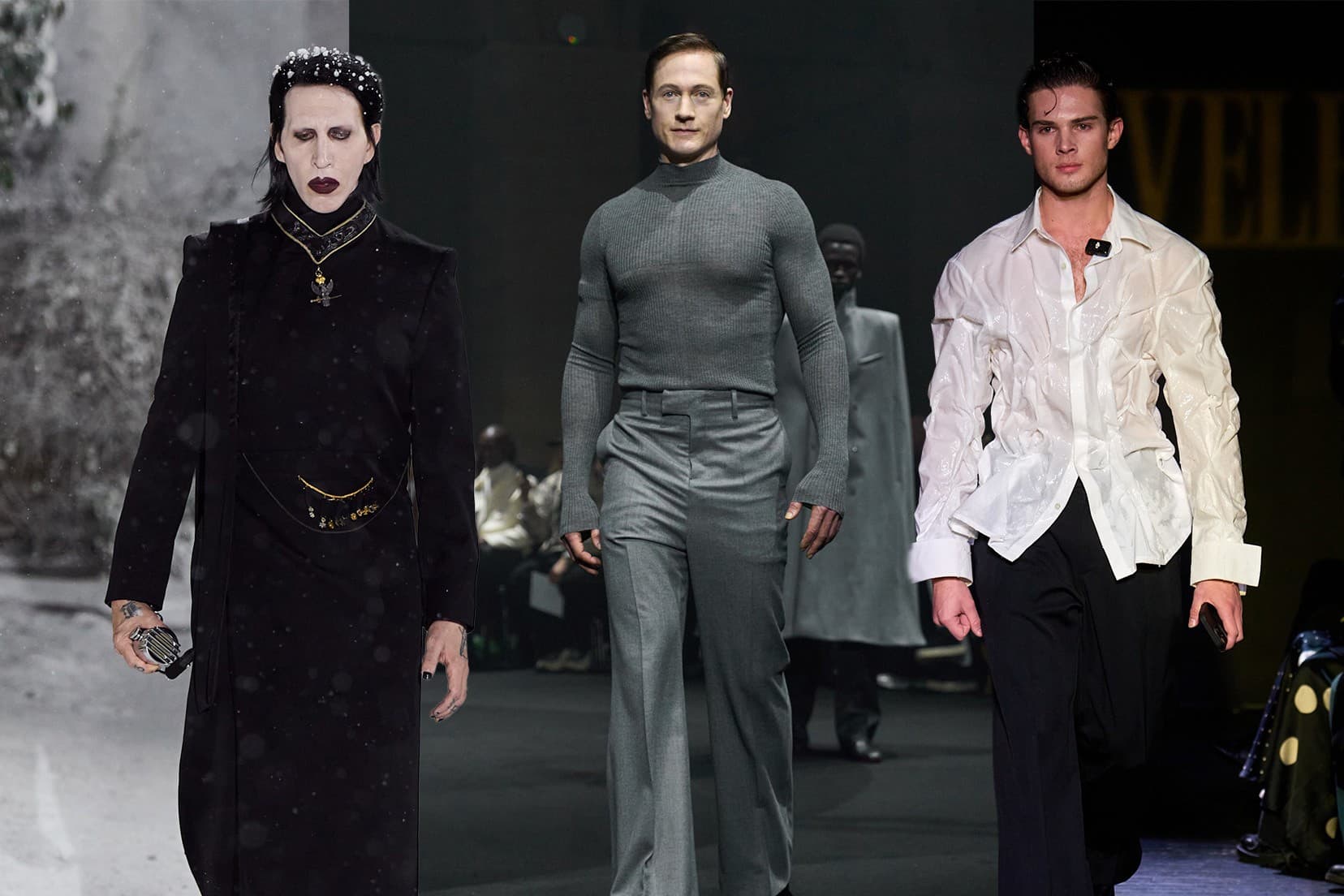
A few years ago, spectacle ruled the runway. There was Bella Hadid at Coperni, who emerged nearly nude to have a dress sprayed onto her body; Demna, at Balenciaga in 2022, who sent models (and Ye, formally known as Kanye West) trudging down a runway in a man-made mud pit, leaving show goers complaining about the stench for days following. And who could forget Ye’s “white lives matter” t-shirt stunt at his own show only days later? Since then, designers have appeared to move on from this kind of shock-jock model, letting their work once again speak for itself. The peak of “Quite Luxury” was swiftly ushered in, and with it, a focus on clothing, tactility, and craftsmanship over viral casting moments and meaningless subversion for subversion’s sake.
Cut to the last Sunday of Paris Fashion Week this season, where regression is in the air. At least, that was the message conveyed when Marilyn Manson (aka Brian Warner) opened Henri Alexander Levyfall’s Enfants Riches Déprimés Fall/Winter 2026 show. Back in 2021, actor Evan Rachel Wood issued a statement alleging Manson as her abuser. She was not the first woman to accuse Manson of sexual, physical, and psychological abuse, though no charges were brought against Manson due to the state’s statute of limitations. As recently as January 2026, a California judge reopened a case against Manson filed by one of his former assistants who has also alleged that she, too, was sexually assaulted by Manson between 2010 and 2011. He isn’t the first creative to give platform to Manson in the wake of these allegations (do we all remember Ye’s Donda collaboration with him in 2021?), and I can’t help but feel tired at the idea that male creatives—especially the ones who fancy themselves with an appetite for the taboo— continuously prove that they do not care about women as long as it gets a conversation going. But what is the conversation here? It is still unclear.
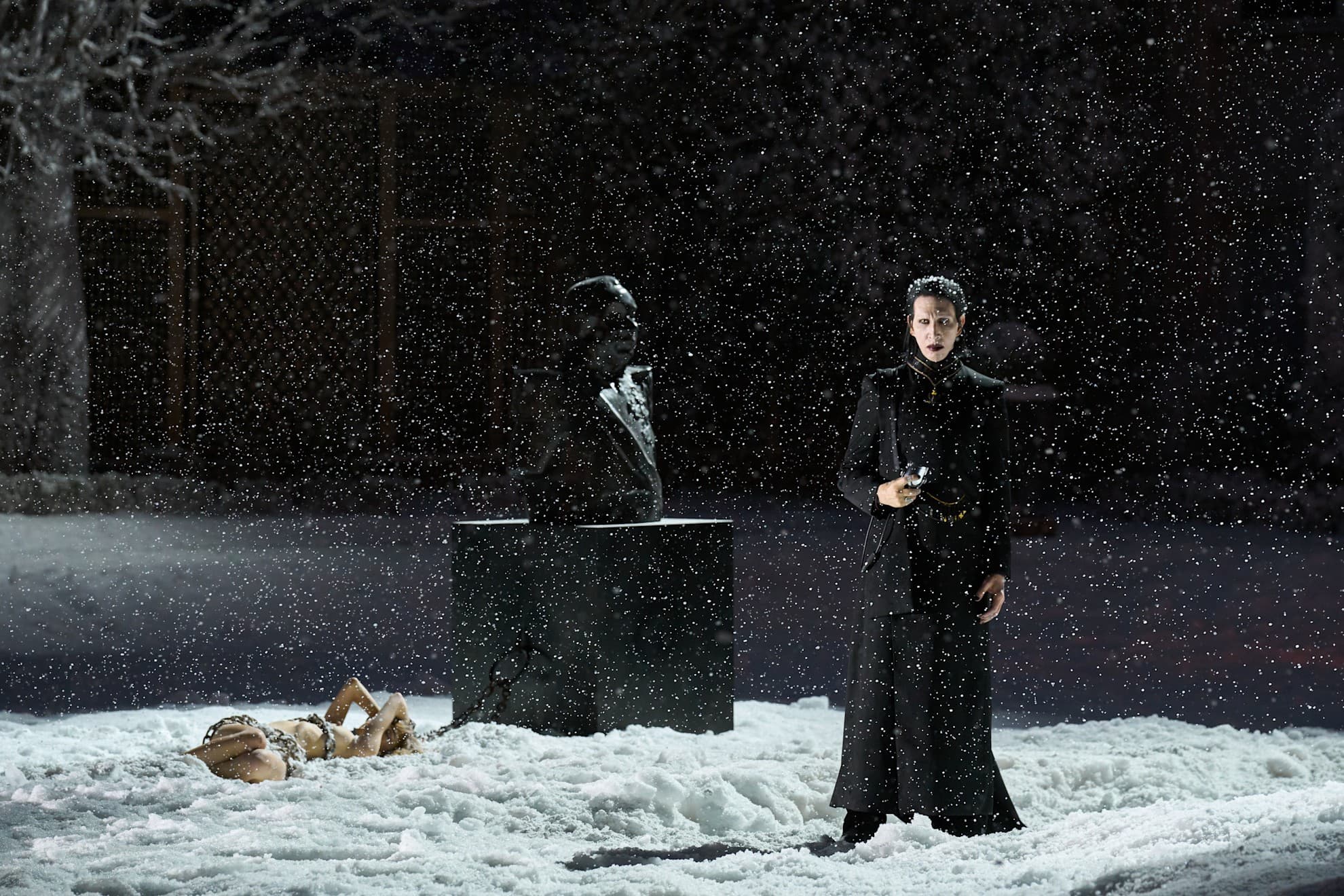 Enfants Riches Déprimés Fall/Winter 2026 Launchmetrics
Back in New York, increasingly controversial designer Elena Velez staged an overstimulating show and decided to have 20-year-old Braden Peters, better known as the internet persona and looksmaxxer “Clavicular,” close the show, flanked by a videographer streaming his runway debut. Peters is best known for giving people advice on how to “ascend” socially through extreme methods such as steroids and “bone smashing,” as well as casually dropping racist slurs and smoking meth on his livestreams. Velez’s front row was populated by figures like the Red Scare podcast’s Dasha Nekrasova,disgraced politician George Santos, in the lineup, the extreme weight loss influencer Liv Schmidt walked the runway.
Levyfall and Velez’s rationales, respectively, for including a range of alleged sexual abusers, racist and misogynistic “looksmaxxers,” and anorexia influencers were so convoluted that their messaging that it not only fell on deaf ears, but backslid so swiftly that any hope of astutely critiquing the clothes fell off the agenda.
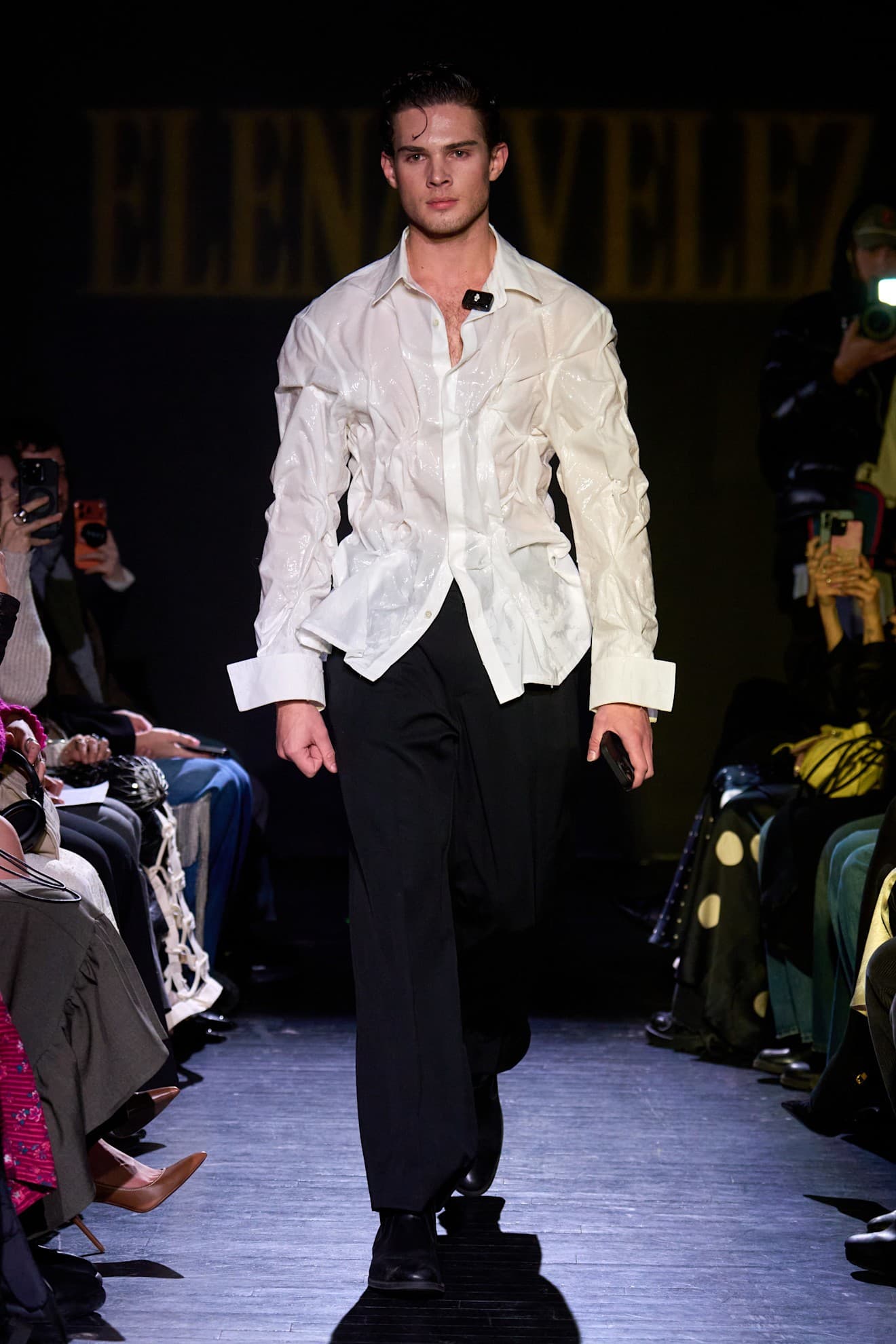 Elena Velez FW26 Launchmetrics
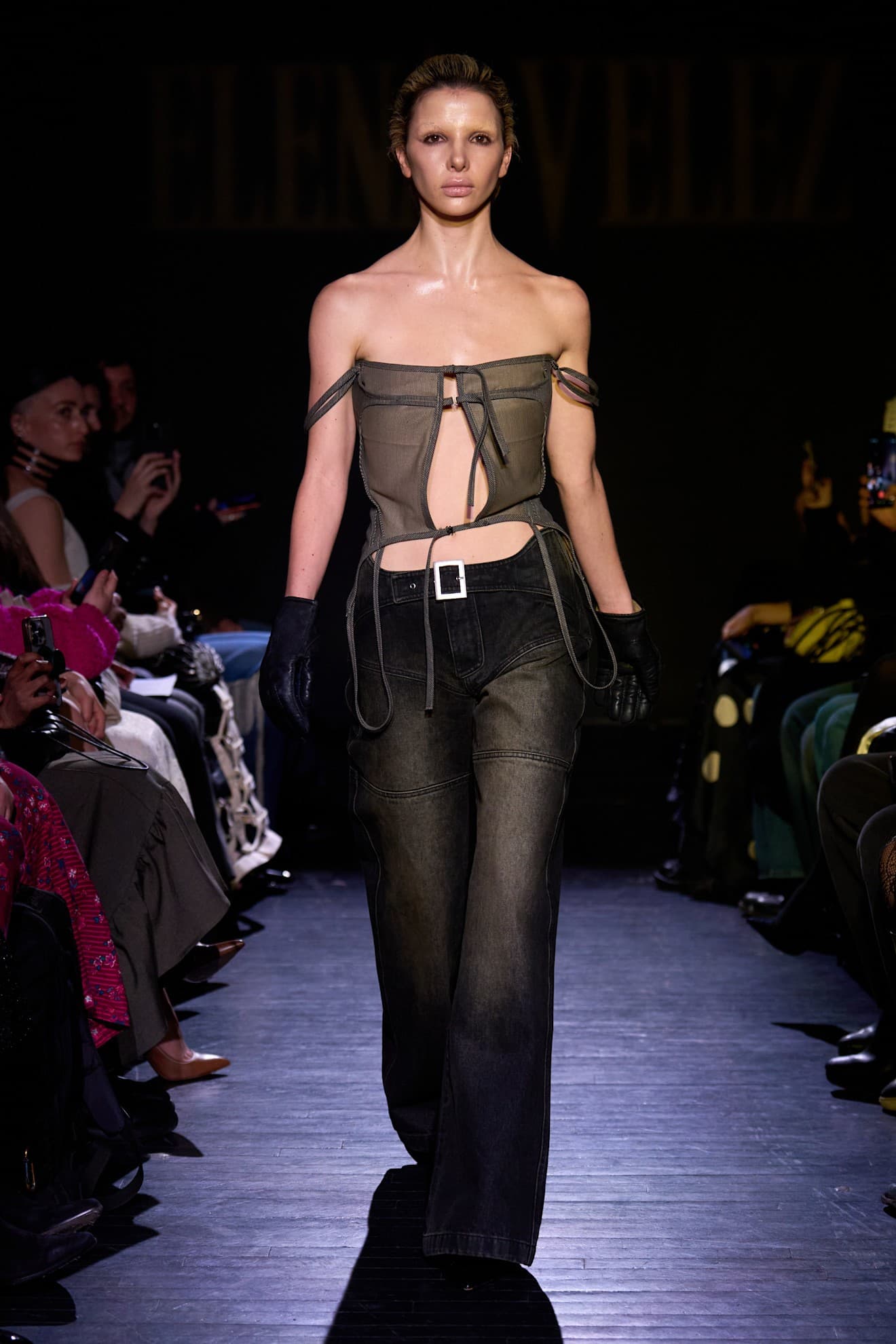 Elena Velez FW26 Launchmetrics
I’ll try anyway. It seems as though Velez, once an LVMH Prize finalist whose potential was grounded in corsetry and construction, has turned over the years to rage-baiting her audience instead of focusing on the development of her pieces. Her fall from grace can first be traced to her Fall/Winter 2024 show, presented as a salon set that discussed Gone With the Wind between The Red Scare’s Anna Khachiyan and The Perfume Nationalist’s Jack Mason. “This is not a commercial season for me, this is really more of a world building exercise,” she told Vogue at the time, that it was “more of an experience of what it means to affiliate with the brand and a very strong outlining of what our values are.” For anyone wondering if she actually aligns with her “post-woke” friends or just wanted to spark discussion.
This was when the attitude towards Velez began to change rather drastically, and for Fall/Winter 2026, it felt as though the designer had given up on trying from a collection perspective. Hems were unfinished, knits were distressed, cheap pumps pierced through knee-high hosiery to create the illusion of a sock boot. What was once a discerning signature of Velez’s work now felt like a missed opportunity for refinement, as though Velez is too preoccupied with upholding her shock-jock identity—one that seems to garner plenty of fringe fans but does little for her position in the industry that she has previously claimed to reject (although she keeps showing on schedule)— than offering something that doesn’t resemble a hasty graduate collection.
In the comments section of a video I saw online about Manson’s disturbing opening for Levyfall’s Enfants Riches Déprimés, somebody wrote, “It’s a shame he makes such great clothes.” I’m not sure that separating the art from the artist is quite necessary here when the “art” in question is shouting almost louder than the artist that they both hate women. (Sunday—the day the show fell on—was International Women’s Day, BTW.) The moody, edge-lord approach that is thinly veiled as pseudo-intellectualism falls short when the centerpiece of the show is a woman in a white bikini, bound by her hands in chains to a statue in the faux snow, with a known perpetrator of violence and sexual abuse against women is sent out in the first look. Whatever hot takes people have had about cancel culture have long since gone stale. Has late-stage capitalism pushed designers so far into a corner that their only option is to rage-bait the press?
This isn’t to say that conversation-sparking incidents on the runway haven’t existed for decades. There was once a time when Tom Ford and Lee McQueen were causing outrage for their boundary-pushing creativity every season. The difference there was that there was a clear dialogue between the clothing and controversy at hand. McQueen’s debut ‘Highland Rape’ collection wasn’t actually about the degradation of women as many people misinterpreted at the time, but a commentary on England’s turbulent history with Scotland. Ford, on the other hand, was exploring sex in fashion at Gucci like no one else had at the time. This was not a one-time stunt, but shaped the language of a brand for so long and so seismically that for years,fans and stakeholders have begged the Italian house to return to his silhouette, criticizing Demna’s most recent homage as missing the mark.
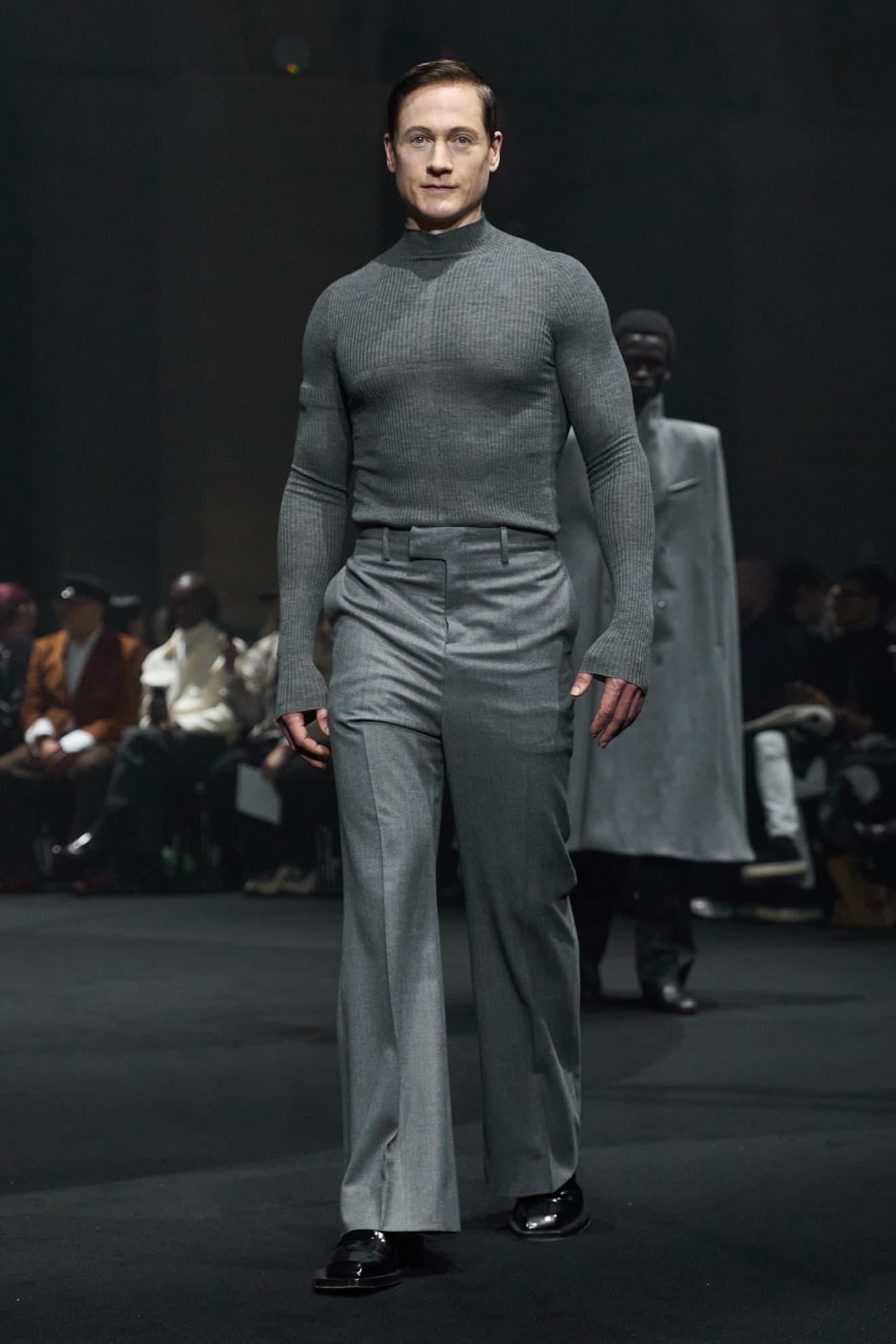 Matières Fécales’ FW26 Launchmetrics
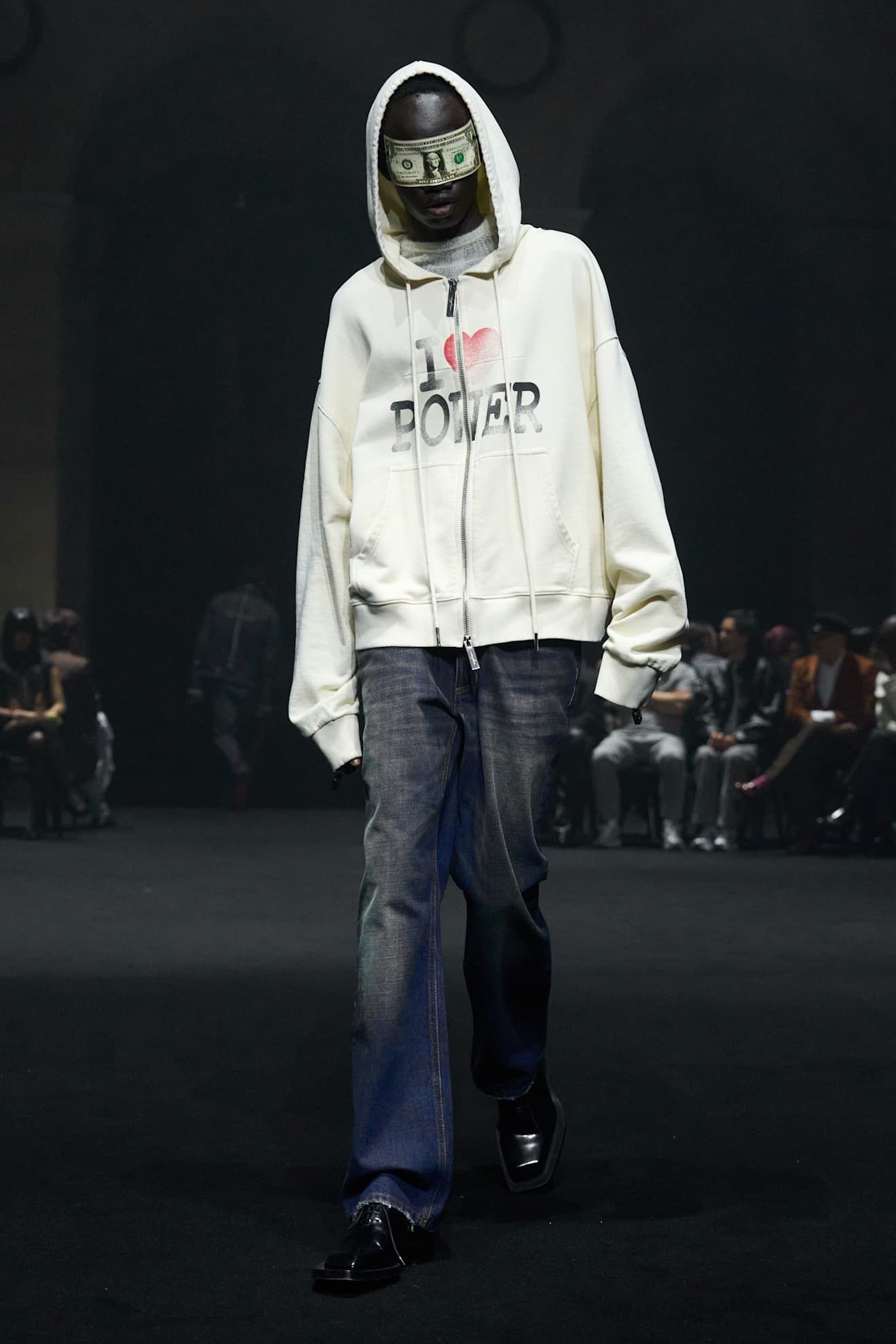 Matières Fécales’ FW26 Launchmetrics
At Matières Fécales’ FW26 show this season, designers Hannah Rose Dalton and Steven Raj Bhaskaran staged a runway show titled “The One Percent,” featuring clothing pieces which also nodded to the horrors of late stage capitalism—bloddied opera gloves, a hoodie that read “I <3 power”, dollar bill eye masks, a cabal of hooded and caped figures in the second half. “Longevity guy” Bryan Johnson also emerged on the runway, famed for his strict, lifelong plight of bio-hacking his body to delay the natural aging process. Controversial as he may be, it was clear what the cultural critique was here, and so Johnson’s somewhat bizarre inclusion in the runway didn’t seem so out of place—rather, it felt like a wry observation of where we as a society are through the lens of satire and cosplay.
Does the presence of the ultra-controversial figures at Elena Velez and Enfants Riches Déprimés actually add anything to the overall storytelling in the collections? It doesn’t seem so. If anything, their presence suggests that the designers are more preoccupied with provoking a reaction than building a visual language strong enough for the clothes to speak for themselves.
These examples do not exist in a vacuum, and it can be argued that when time-frame and context is so far from the 90s, the exploration of transgression simply does not land the same, especially when you are doing so on the heels of abusive, misogynistic men.
Fall/Winter 2026 was a season that offered beautiful clothes. Jil Sander’s Simone Belotti created a truly perfect collection that reframed the current mindset on minimalism, Louise Trotter gave the Bottega Veneta customer clothing laden with power and structure, while at Chanel, Matthieu Blazy offered another hit of pure levity with psychedelic colours and loose, joyful silhouettes. The clothes were more than enough. We have reached the peak of spectacle. I’d rather be moved by other means.