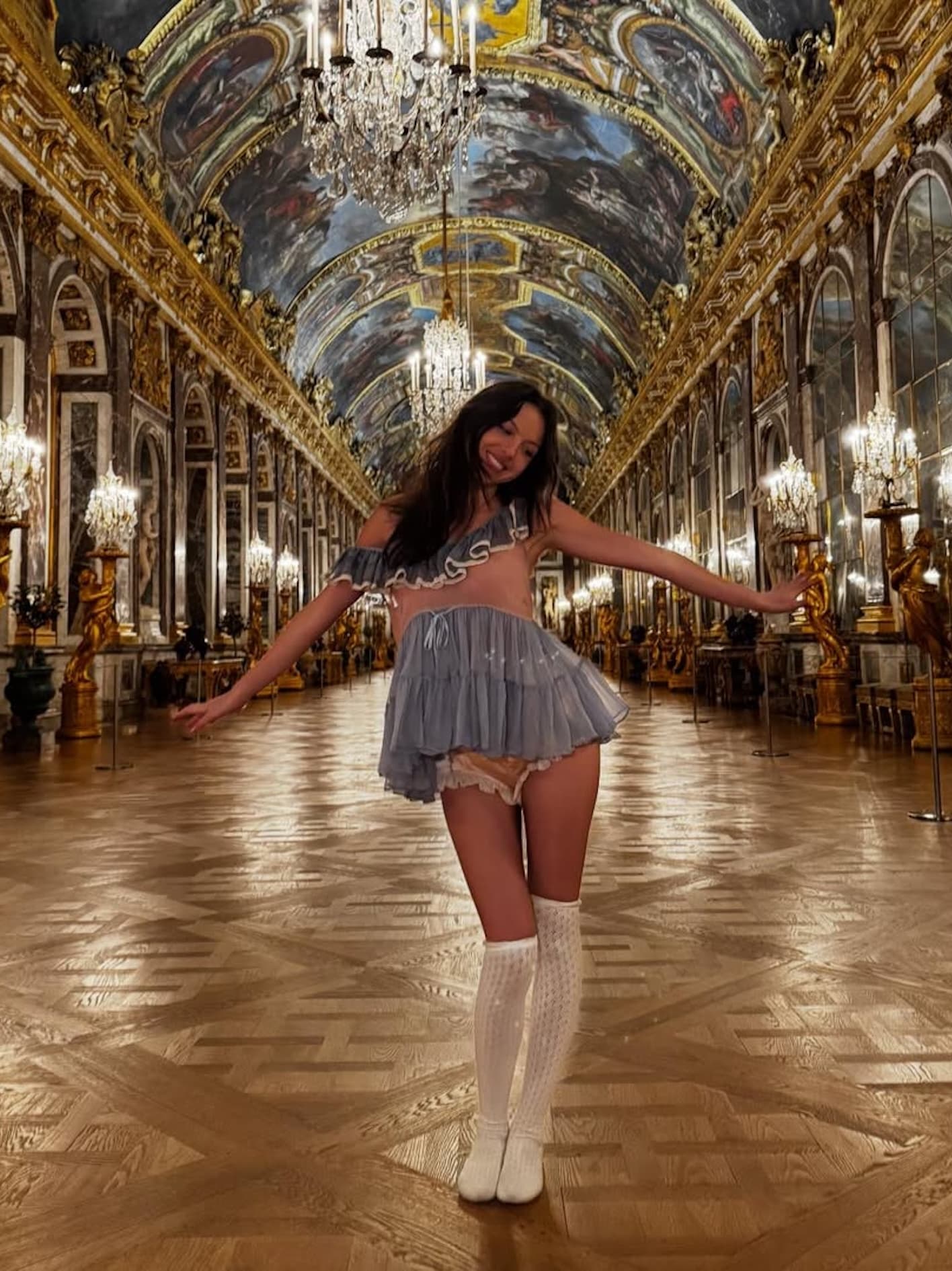
Two days ago, after furiously responding to what felt like countless bad takes, I decided to send out an honest, albeit trolling thought via Threads: “fine, I'll say it,” I wrote, “Olivia Rodrigo's dress should be shorter.”
The “dress” in question is actually a hand-embellished puff-sleeve blouse made for adult women by Istanbul-based fashion brand Generatio78. Rodrigo had styled the girly oversized top with frilly bloomers and calf-high Dr. Martens for her Spotify Billions Club Live performance in Barcelona. In the wake of the performance, however, the internet was in a frenzy over whether or not wearing the outfit was "appropriate," given what some described as the current “Epstein climate.” In their minds, Rodrigo dancing around on stage and singing lyrics about love in that particular fit was an act of infantilization, all to court the pedophilic male gaze.
Obviously, I disagreed, and my inner dialogue gone public, quickly racked up 55,000 views as people argued with me in the replies. And though some well-intentioned critics argued that it is healthy in this day and age to question why artists make specific outfit choices for performances, others stood firm in their belief that her decision was nefarious, that some male bigwigs in the industry had paraded her out as some dog whistle for creeps, and worse, she had knowingly taken part in it. Despite it making zero business sense for the star to pivot to marketing to the male gaze (Olivia Rodrigo’s audience is mostly Gen Z, the demographic currently spending the most on music), there are countless threads —so many that Rolling Stone questioned if it was a bot campaign against the singer—policing her wardrobe.
In a frenzy of novice-industry specialists (many of whom were men who tried to explain music marketing to me, my 10-plus years in the industry be damned) and psychics who just know her intention was to be a sexy baby, I tried to better understand everyone else’s perspective, and I’ve still come to the conclusion that her dress could, in fact, be shorter. Thus, with a “Baptist preacher’s daughter who had to change out of her Abercrombie denim skirt too many times before going out” sized chip on my shoulder, I took part in the discourse.
 Xavi Torrent/Getty
The first argument I tackled was the idea that Olivia just wasn’t counter-culture enough to wear a baby doll fit “kinderwhore” (i.e. the juxtaposition of soft and gritty; see: retro pastel cardigan styled with Mary Janes, black lipsticks, pigtails, and safety pins). Rodrigo herself, in a chat about the aesthetic around her upcoming release, You Seem Pretty Sad for a Girl So in Love, told Vogue that for this album era, she wanted to wear something that reflected the lovelorn thematics of her new songs, looks that denoted she was in a dream-like state. She described looks as “pajama-y” and spoke about having “pictures of Courtney Love and Kat Bjelland from all these riot grrrl punk bands in their babydoll dresses, just owning it” as part of the inspiration for her silhouette choice. However, the internet, taking part in the age-old tradition of assuming women don’t think for themselves, decided that not only was Rodrigo’s look decidedly not embodying the ethos of her rock foremothers, but that Olivia was, in fact, the issue with the outfit. She just wasn’t as “transgressive” enough to pull the look off with sincerity. As those claims started to swarm my feed, I could feel my fingers reach for the keyboard again. “Olivia Rodrigo calling out Trump, defending immigrants and passing out plan B at her shows is more transgressive than courtney love using the N-word but go off queens,” I typed. I pressed send to the tune of 170k views.
Listen. I get it. Multiple things can be true. Love has been vocal in women’s rights cases and spoke out against Weinstein, and arguably should not have caught strays in this discourse. She inspired countless women to pick up guitars, and more importantly, her public persona was one that was shameless, outrageous, and still feminine when many women felt they couldn’t be all those things at once. Her art and contributions are not lost on me. But many of her fans (at least the ones in my comments) weirdly don’t believe that a middle finger is a middle finger regardless of its color, when pointed at the status quo. The idea that Olivia “energetically” can’t make a babydoll dress because she’s not counter-culture enough in comparison to her white counterparts just sounds like amplified subconscious white feminist bias, particularly when aimed at a bi-racial Asian woman.
Another user noted that the real issue was “The aesthetic that she cherry-picked pieces from and is currently displaying isn’t transgressive, and I think that’s the bottom line.” When asked to expound, they explained that it came down to how she wore it—“all she took was the baby doll dresses, not the makeup, not the runs in the tights, not the messy hair, so of course it doesn’t translate.” I have a very hard time believing smeared lipstick and tights with runs in them would’ve saved her from these particular critiques, especially since the majority of them don’t note styling at all.
One person responded that it was the subject matter of her music, “I don’t think most of it is countercultural, which riot grrl was. It’s often catchy songs about relationships, which is fine to enjoy. Just don’t tell me it’s rebellion when it isn’t.” This take, I think, is fair, though I don’t think most people commenting on Olivia’s sonics listen to her music to hear the artist she’s inspired by, they don’t know that she got one of her favorie bands '90s indie/alternative rock act to open for her big MSG shows or that she’s paying it forward to future rising rock starsl ike Grace Ives, who is opening for her upcoming tour. They also don’t seem to recognize that she’s been actively vocal about domestic and international political issues, while most pop stars are quiet.
But the scariest takes I read were ones where women squarely put the burden of safety on themselves and other women when it comes to predatory men. I’m talking about well-meaning women, who likely see themselves as feminists, explaining to me why my belief that women should be able to wear short frilly dresses made me “unsafe” and that, because men aren’t being held accountable for their actions, “Hypervigilance is the only way for women to keep themselves safe.”
 Instagram.com/oliviarodrigo
I hate a bad take, but I feel for this argument. It’s the same one my Black parents made when they told me not to wear pajamas in the car while driving in the South, because they thought I’d be less likely to be profiled. Or, the reason why an innocent 17-year-old was asked to go back upstairs and change out of her Abercrombie skirt. We’re all grasping for some level of control, some hope that if we could just dress, behave, or live differently, we won’t become prey. But longer hemlines aren’t going to save us.
The only people responsible for pedophilic or predatory behavior are the people taking part in it. Putting the responsibility and burden of abusive men on women (or pop stars) plays right into the purity politics they are parading out to control us. Puritan politics are dangerous. They are the reason we’ve lost access to abortion rights, the reason there are no men in jail currently for the Epstein files. So yes, Olivia’s dress should be shorter, or longer, or whatever length, color, or pattern she desires—because policing her clothing isn’t going to get us closer to a world where women are safe to exist in all forms. It just sees us playing right into the hands of the people who set up this system in the first place.