When model and it-girl Gabbriette Bechtel got married to Matty Healy last month, many of us paid special attention to her dress: a white silk taffeta hand-pleated gown with a bodice, a triple bustle, and a train with déchiré tulle edges at the back. Her designers of choice for the custom masterpiece? Hannah Rose Dalton and Steven Raj Bhaskaran, of the Paris-based brand Matières Fecales, translating to “fecal matter”.
The dress, and the two pre- and post-party looks the design duo created for the bride, garnered a particular level of attention for the brand. It was, after all, the first bridal look Dalton and Bhaskaran had ever created, but it certainly isn’t the first time they’ve done a custom celebrity look.
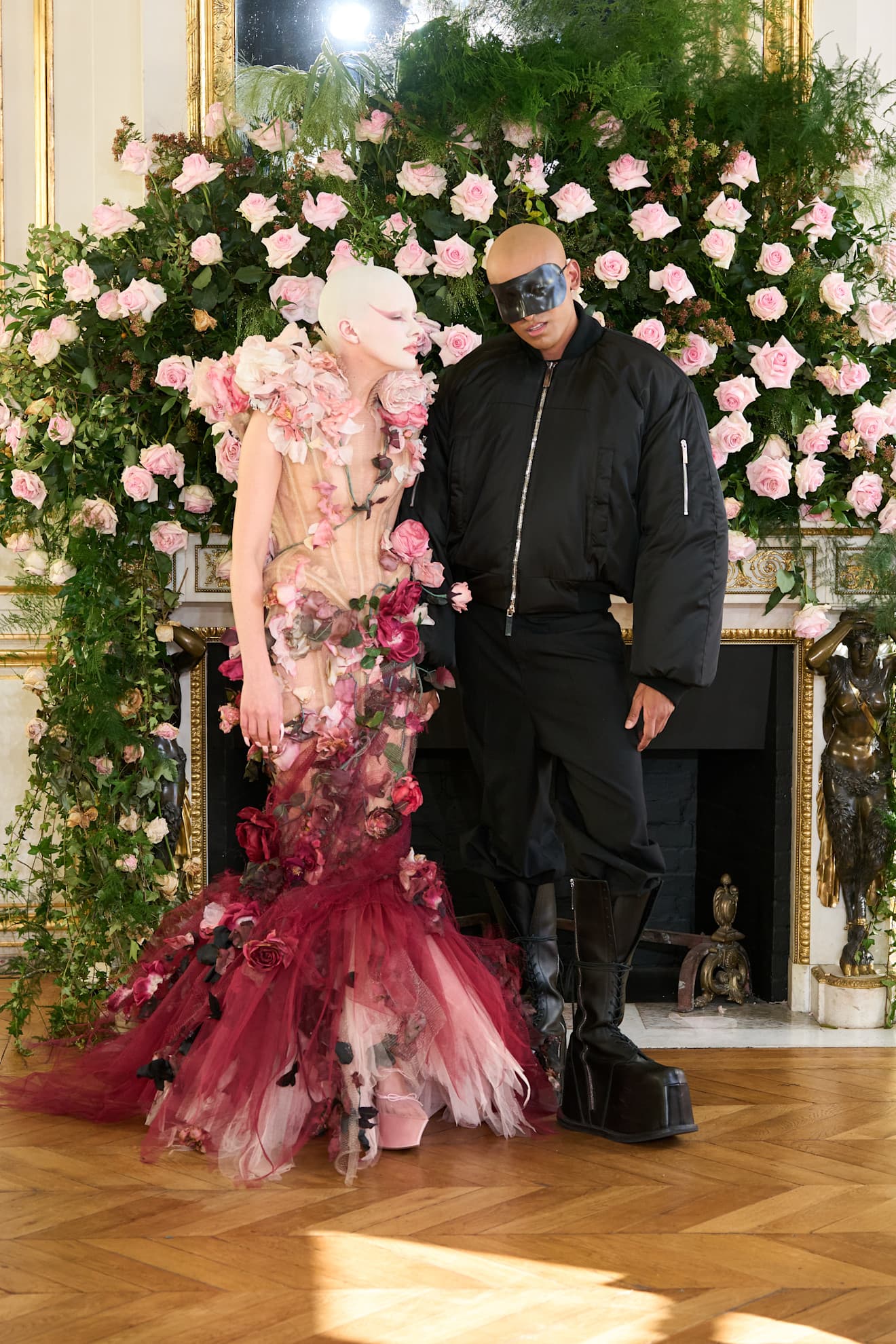
Matières Fecales is known best for their couture-like pieces that marry subversion, the grotesque, and mythological themes with dark romance, cultural commentary, and theatre. It has appeared on countless celebrities in recent years—from on-stage and red carpet looks for Lady Gaga to Met Gala outfitting for Sarah Paulson and The Marias’ María Zardoya, and more recently Zendaya for The Odyssey press tour—and the duo are no strangers to creating a viral moment.
This extends to their collections, too, telling stories on the runway that land controversially for some, ironically for others, and astute to most. Through commentary on the bourgeoisie, the toxic excesses of fashion, and the duo’s devotion to craftsmanship, Dalton and Bhaskaran have created one of the most talked-about shows on the Paris Fashion Week ready-to-wear calendar for multiple seasons now. But it wasn’t always this way for the Canadian designers, whose origin story has become its own lore at this point. Launching their brand under the English translation Fecal Matter in 2014, they started selling their pieces on Depop while squatting in a New York club and DJing on the side, all to make ends meet for their one-of-a-kind clothing venture. It was their viral skin shoes that caught the attention of Rick Owens—who the pair now consider a friend and have collaborated with plenty of times—before being scooped up into the Dover Street Market family by Adrian Joffe.
Since then, the brand has continued to grow in both ready-to-wear and custom categories, and ahead of their fourth ready-to-wear show on the official Paris schedule, during a dinner with Atlanta-based retailer ANT/DOTE, we caught up with Hannah Rose Dalton and Steven Raj Bhaskaran to learn more about their plans for Spring/Summer 2027, and the challenges they face as an independent brand.
 Photo: Hannah Rose Dalton & Steven Raj Bhaskaran // Launchmetrics
Your collections often feel like a commentary on the state of the world. How are you feeling about the world right now?
Hannah: “It's just kind of an ugly time, and it's really hard to just sit there and not say anything. So I guess that's how we feel, no?”
Steven: “But at the same time we feel optimistic. I think there's a lot of optimism for us, and I think we're excited to sort of see the rise of a new perspective, which I think obviously is not just true to us, but true to so many other creatives out there. I think that in such difficult times, whether it's political, whether it's social, I think the rise of sort of fearlessness is always really important. And I think that's something that we're optimistic about, to see more fearlessness.”
Is there anything you can tease about your Spring/Summer '27 collection?
HRD: “I think it’s just a personal one.”
SRB: “The next collection is going to be very personal, very driven and rooted in lived experience. So it's going to be a very, very special show that I think has been a little bit in the making for a very long time actually.”
 Photo: Matières Fecales FW26 // Launchmetrics
 Photo: Matières Fecales SS26 // Launchmetrics
What feels like the biggest challenge for an independent brand at the moment?
SRB: “I think the biggest challenge is to not fall into the pressures of all of the other bigger brands. I think it's so easy to sort of look at those bigger brands and just mimic what they're going through and feel also like what you're doing is not good enough. But I think that there's so much power in emerging talent and the power that they have is through just being authentic and telling their story and having also the intimacy of a smaller team, of less resources, of maybe a more direct communication to their clients or the press. But I think it's actually a very powerful advantage, because it just means that how we communicate as emerging talent is perceived in a more human way versus a sort of conglomerate way. And I think that if we live in an era where connection is key and connection is also so prioritized, I think what better time to be emerging and to have a human-to-human connection with your work.”
Can you tell us about Gabriette's wedding dress? How did that come about? And what was the inspiration?
HRD: “I mean, she kind of reached out to us actually, and we'd never done a bridal look before. So it was really an exciting project. And to get to know her, I mean, obviously such a muse for us to begin with, but to get to know her on a personal level just as human to human was so nice.”
SRB: “I sketched all the looks. I sketched a lot of looks. And then with her, we sort of looked at it, and she was super excited. And then we went into making some of the looks, and she basically, it was like, what's that show where you choose a dress?”
HRB: "Say Yes To The Dress"
SRB: “Yes, it was! We made a lot of options, and she was able to basically feel what felt the best. We had to start over a few times because it just wasn’t there. But then, I think for her, it was a process for her to get clearer and clearer in what she wanted. Luckily for us, it was really exciting because we got to do things that we never really did before, whether it's like a Victorian silhouette or whether it's working with silk taffeta, which is a very specific fabric. But in the end, it was a result of sort of a very personal creation that can really be only worn by her because it was made for her. So it was a very special experience and it was our first bridal experience. So being there with her mom, looking at the dress and her family and her best friends, it was an eye-opening moment for us to realize that creating bridal is different than making couture or ready-to-wear or any collaboration stuff that we do. It's actually a lot more intimate and personal, and it's sort of centered around love, which I think for us specifically, that's an important thing in our relationship. So it was important for us to also embody that through the process and also the creations.”