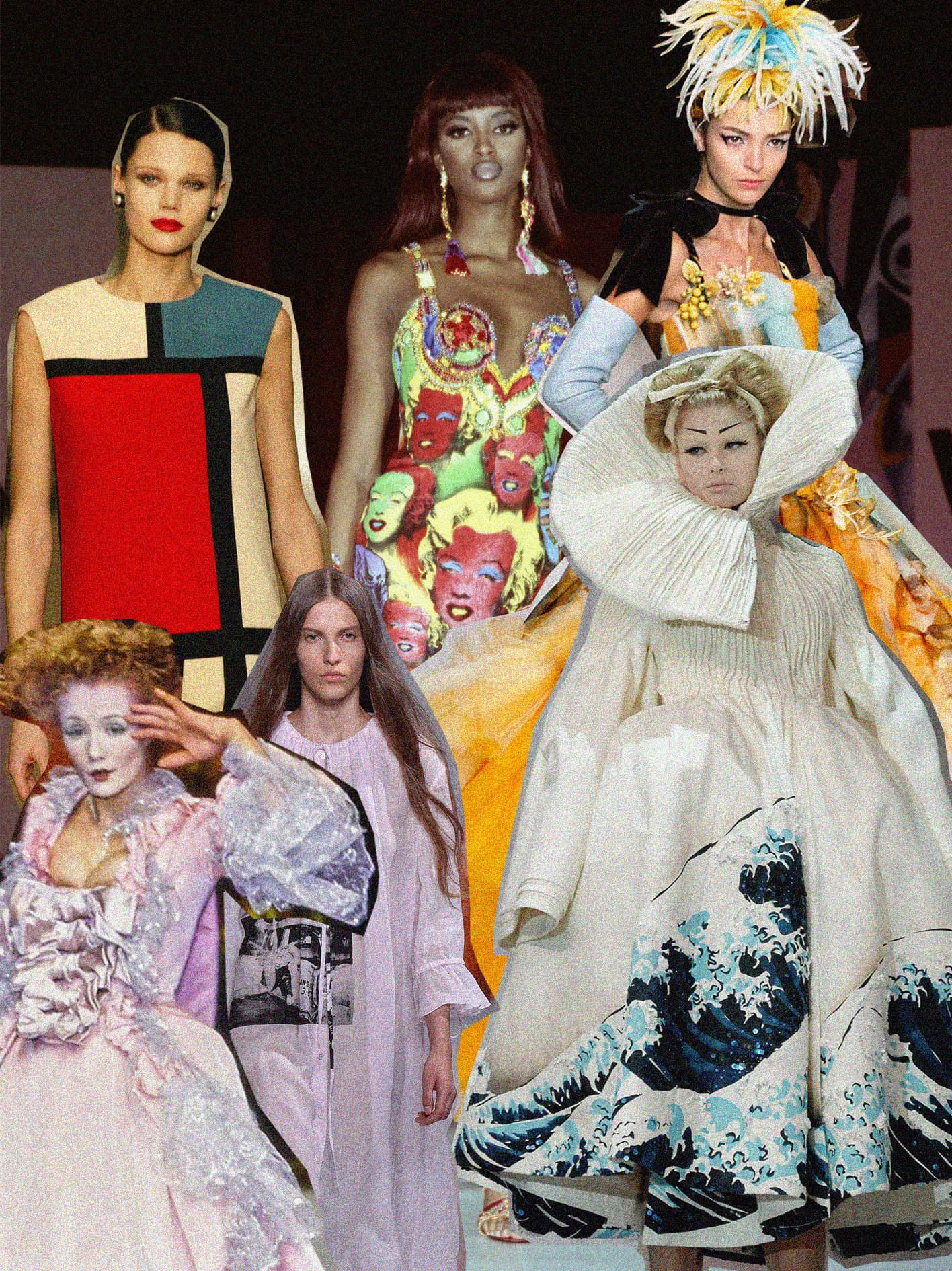
The Met Gala is fast approaching, and this year's Met Museum exhibition is all about costume art. With a corresponding Gala dress code of "Fashion Is Art", encouraging attendees to express their relationship to fashion as an embodied art form—something designers have been doing for decades, making this year's theme the perfect opportunity to dive into the archives.
Throughout history, designers have explored the interplay between the fashion and art world in both a literal and referential way, through famous collaborations with designers (Like Louis Vuitton X Takashi Murakami, Elsa Schiaparelli and Salvador Dali), independent explorations of the body as artistic representation, and clothing as artistic expression.
From Yves Saint Laurent's longstanding fascination with specific artists to Vivienne Westwood's enduring inspiration from the Rococo era, we round up ten times fashion and art collided on the runway and beyond.
Yves Saint Laurent Fall/Winter 1965, Piet Mondrian
 Composition with red, yellow, and blue, 1921, by Piet Mondrian (1872-1944) / DeAgostini/Getty Images
 Yves Saint Laurent's SS02 haute couture / Fairchild Archive/Penske Media via Getty Images)
Perhaps one of the most well-known examples of fashion and art directly colliding is Saint Laurent’s Mondrian. Singularly referencing Piet Mondrian’s geometric compositions, Saint Laurent translated the abstract paintings into jersey shift dresses. Here, Saint Laurent offered a garment that operates with the same visual logic as the artwork it references, by using 60s mod shapes to communicate a contemporary silhouette.
Elsa Schiaparelli x Salvador Dalí Lobster Dress, 1937
 The Lobster dress from 1937 designed by Elsa Schiaparelli and Salvador Dalí /Dominique Maître/WWD/Penske Media via Getty Images
 "Lobster Telephone" by Salvador Dali / Getty Images
Elsa Schiaparelli and Salvador Dalí’s enduring partnership established an early model for the fashion and art exchange, rooted in their shared love and dedication to surrealist principles. The lobster dress is one of their best known examples. The motif was printed on a silk organza evening dress and was part of the 18-piece collection Schiaparelli designed for Wallace Simpson, after her marriage to the Duke of Windsor. The idea for the print was inspired by Dalí’s 1936 piece, Lobster Telephone.
Versace Spring/Summer 1991, Warhol Collection
 Versace SS01 / George Rose/Getty Images
Gianni Versace reportedly was quite the fan of Warhol, both as a man and an artist, and chose to collaborate with him in 1991, where he printed Warhol’s screen prints of Marilyn Monroe and James Dean on various pieces throughout the collection, most famously a gown that Naomi Campbell wore in the show. The collection underscored both Versace and Warhol’s shared interest in visibility, repetition, and the mechanics of fame.
Alexander McQueen Fall/Winter 2009 “The Horn of Plenty”
 Alexander McQueen FW09 / Victor VIRGILE/Gamma-Rapho via Getty Images
McQueen’s work consistently referenced art history as a structural rather than decorative framework, and his Fall/Winter 2009 collection, “The Horn of Plenty” was no exception. The collection drew on still-life traditions and earlier McQueen archetypes to construct a layered commentary on excess and consumption. Rather than quoting specific works, it operated through accumulation—turning references into a system of critique embedded in silhouette and staging.
John Galliano for Christian Dior Couture Spring 2007
 Christian Dior SS07 Haute Couture / Chris Moore/Catwalking/Getty Images
Galliano’s long standing relationship to art is well documented throughout his tenure at Dior and later at Maison Margiela, but his Spring/Summer 2007 couture collection for Dior was a standout. Galliano used Impressionistic references through atmosphere rather than literal copies, with references to Claude Monet, as well as a dress depicting The Great Wave off Kanagawa. The collection reinforced Galliano’s broader approach at Dior, where historical art movements were reinterpreted through theatrical couture rather than replicated.
Comme des Garçons Spring/Summer 1997
 Comme des Garçons SS97 / Getty Images
Rei Kawakubo’s Spring 1997 collection is one collection that leans heavily on the influence of sculpture rather than replicas of print or direct, famous artworks. The exaggerated padding and distorted silhouettes challenged conventional readings of the body, positioning clothing as spatial construction. It remains a key example of fashion functioning within a conceptual art framework, a code that Comme des Garçons is so famously known for.
Viktor & Rolf Fall/Winter Couture 2015
 Viktor & Rolf Haute Couture FW15 / Pascal Le Segretain/Getty Images
At Viktor & Rolf’s Fall/Winter 2015 couture collection, the couture brand chose to reference the relationship between fashion presentation and gallery display. The collection was heavy with pieces constructed to replicate historical paintings, presented as framed works before being “removed” and worn.
Calvin Klein Fall/Winter 2018, The Andy Warhol Foundation for the Visual Arts
 Calvin Klein SS18 / Catwalking/Getty Images
 Andy Warhol's White Disaster (White Car Crash 19 Times), 1963 / Alexi Rosenfeld/Getty Images
When Raf Simons was briefly at the helm of Calvin Klein, the Belgian designer embarked on a collaboration with the Warhol Foundation, and integrated archival imagery into his Fall/Winter 2018 collection for the American brand. Rather than presenting Warhol as motif, the collection embedded his imagery within American archetypes, from suburban codes to cinematic references.
Vivienne Westwood Fall/Winter 1995, The Wallace Collection
 François Boucher, Marquise de Pompadour, 1759 (1956) / The Print Collector/Print Collector/Getty Images
 Vivienne Westwood FW95 / Getty Images.
Westwood’s Fall 1995 silhouettes displayed an engagement with the Wallace Collection. Rococo imagery, has served as a reference point for Westwood throughout her entire oeuvre, and specifically in her 1990, 1993, and 1995 collections, where she frequently referenced gowns from paintings by François Boucher.
Jean Paul Gaultier Spring/Summer 2003 Couture, Edgar Degas
 Dancer with a bouquet on the stage (Danseuse au bouquet, saluant sur la scene), 1878, by Edgar Degas / DeAgostini/Getty Images
 Jean Paul Gaultier SS03 Haute Couture / PIERRE VERDY/AFP via Getty Images
For Jean Paul Gaultier’s Spring/Summer 2003 couture collection, the French designer drew from Degas’ studies of dancers. One dress in particular, replicated one of Degas’ ballerina paintings, which went on to be worn by Beyoncé in 2003 in a shoot for ELLE Magazine, and was recently reworn by Chappell Roan on the red carpet.