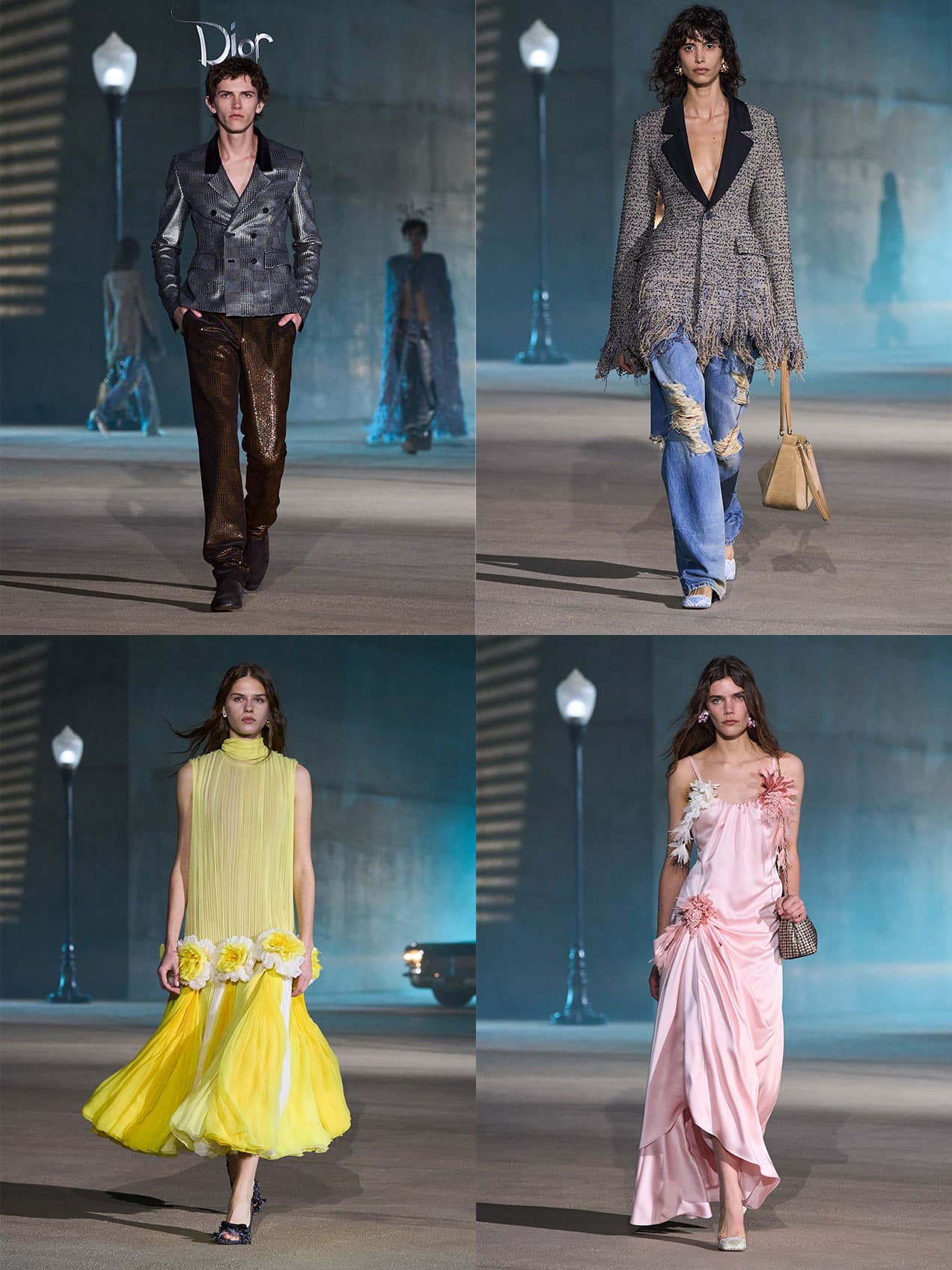
Jonathan Anderson has always been heavily interested in film and the beast of Hollywood. One only has to notice his history with ambassadors—some of the most exciting acting talents of our generation like Greta Lee and Taylor Russell—to understand this connection. But he’s not alone in his fascination; he shares it with the late Christian Dior. The house of Dior’s connection to film, and to film stars, has been well documented on the red carpet throughout history, dating back to 1942, when Monsieur Dior designed the costumes for Le Lit A Colonnes before Dior was even Dior.
In 1950, Marlene Dietrich starred in Alfred Hitchcock’s Stage Fright wearing a jacket from Monsieur Dior’s 1949 Spring/Summer haute couture collection (“No Dior, no Dietrich,” was the famous line which stipulated she wouldn’t star in the Hitchcock film without Dior wardrobing), and from there, Christian Dior became couturier to the darlings of Hollywood, dressing everyone from Audrey Hepburn, Marilyn Monroe, Elizabeth Taylor, Grace Kelly, and Sophia Loren.
 Launchmetrics
 Launchmetrics
Parallels can be drawn here between the late designer and Anderson, who showed his debut Cruise collection for the house last night. Who can forget his close relationship with director Luca Guadagnino and the role he played designing the costumes for both Challengers and Queer? So the news that his next show, Dior Cruise, would be in Los Angeles felt like no surprise. But what delights us all about Anderson is what we see go down the runway.
 Launchmetrics
 Launchmetrics
The show took place at the Los Angeles County Museum of Art on Wednesday evening, outside, amongst a throng of parked vintage cars and faux street lights to create a film noir effect, and a soundtrack of Air’s Sexy Boy and Kelly Watch The Stars. Anderson’s formula at Dior is emerging ever-so-subtly, with the first three exits acting as different interpretations of the same silhouette. Last season it was miniature jackets with waterfall skirts; this season, it was a procession of pleated georgette dresses with a cluster of rosettes at the hip in yellow, purple, and black, followed by a Bar Jacket, frayed at the edges and paired with distressed blue jeans and a suede shoulder bag to dress it all down—a knack Anderson has always been deft at.
 Launchmetrics
 Launchmetrics
Then, all glamour. Silk slip dresses were gathered at the hip and adorned with floral appliqués, dresses were weighted with chiffon 3D poppy heads and beading, singular chainmail earrings that dripped from lobes and flora boas that trailed out of hems to the floor. Two notable collaborations emerged: one with the famed pop artist Ed Ruscha, who Anderson worked with with on shirting emblazoned with some of Ruscha’s classic slogans, and the other with his long term hero Philip Treacy, who created feather headdresses spelling out the words STAR, FLOW, and BUZZ. Some might recognize the silhouette from Isabella Blow’s famous BLOW headdress, which Treacy created for the late fashion icon.
There were plenty of references to those who have come before him, too. Like the reinterpreted Dior Saddle bags from Galliano’s era that have been adjusted into coin purse-like clutches, and larger, pillowy clutches featuring his famous newspaper print. The slouchy suede shoulder bag, too, came from Marc Bohan’s era, and as always we cannot look at appliqué and sequin floral dresses quite the same after Raf Simons’ stint.
 Launchmetrics
 Launchmetrics
All of this came together through the juxtaposition of additions like denim and plaid. Denim was distressed and the frayed gaps were embellished with diamontés, while plaid was cut in transparent chiffon, which was layered over exaggerated Bar Jackets and left to trail behind models, and simple button down shirts were adorned with Ruscha’s words. This inclusion of seemingly ordinary pieces felt like a perfect metaphor for the effect of Hollywood and Los Angeles as a whole. The proponent of a dream, the glamour of something seemingly ordinary that seen through rose colored glasses. Los Angeles is, after all, cloaked with an underbelly that collides with the sparkliness like no other place on earth. That’s part of what makes it so revered, and Anderson interprets this expertly through the lens of something new. If Hollywood is the “dream factory,” Anderson makes a compelling case for being a master manufacturer.
 Launchmetrics
 Launchmetrics
 Launchmetrics
 Launchmetrics