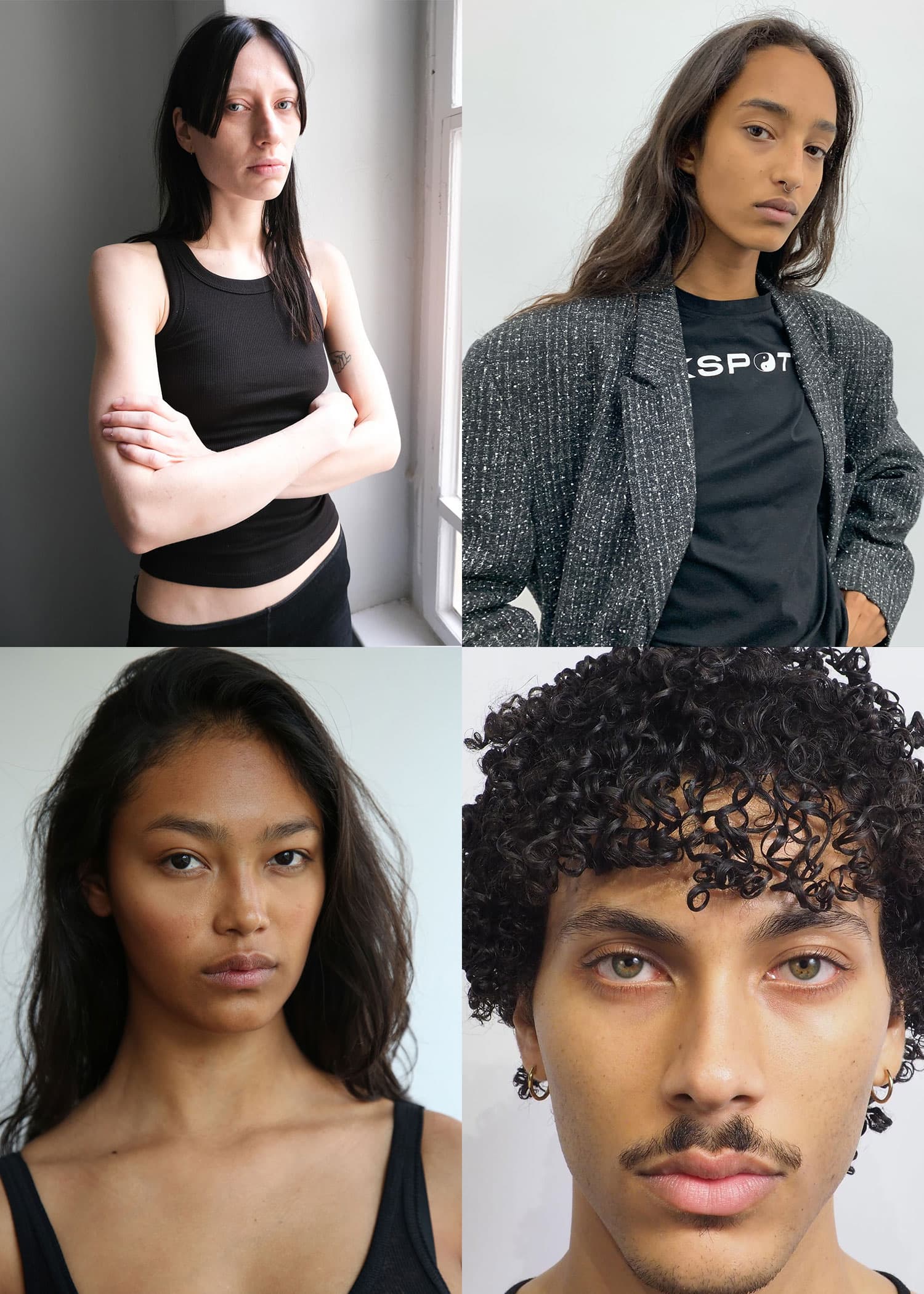
For decades, the casting industry has operated by its own set of rules. Trends come and go, but the fashion industry always finds a new obsession. In recent years, that meant influencer casting, a new generation of supermodels with massive social followings, and faces discovered far beyond the traditional agency system.
Back in 2016, street casting was the method of choice for spotting the next big model. The more unconventional the face, the better, spurred on by creative directors like Alessandro Michele, who was at the height of his career at Gucci at the time, and casting agencies like Midland Agency, the boutique casting and model agency that spearheaded unconventional street casting in the New York City scene.
Then came Demna. At Balenciaga, agency models shared the runway with "real" people—friends, artists, musicians, and total unknowns whose appeal came from their presence rather than their walk. Those casts were often shaped by a mix of traditional power players, like Piergiorgio Del Moro, and collaborators such as stylist and creative director Léopold Duchemin, who helped source many of the show's most memorable faces.
That approach hasn't fully disappeared. At his debut Gucci runway show this February, Demna worked with Piergiorgio to assemble a runway cast that represented a cultural snapshot. We saw established icons like Kate Moss and Mariacarla Boscono flanked by the new guard of supers—Alex Consani and Amelia Gray—alongside Instagram It girls like Gabbriette and Meredith Duxbury, and faces plucked from obscurity, like the Calgary college football player, Gavin Weiss. Anyone familiar with Demna's Balenciaga era—from Nicole Kidman to Kim Kardashian—knows his fascination with celebrity isn't going anywhere.
Beyond celebrity, though, diversity seems to waning. . What once felt like a collective push toward broader representation—across body types, ages, and backgrounds—has become noticeably less visible on many luxury runways. "Brands talk about representing the whole world, but the spaces for that are shrinking," casting director Carlos Castellanos of In The Park Management says. There are fewer and fewer luxury brands pushing body diversity—if at all. While many brands still prioritize racial diversity, casting directors increasingly point to a familiar reality: thinness and whiteness are once again becoming the default.
So what does it actually take to discover fashion's next faces? We spoke with four casting directors working across both traditional and street casting to understand how the industry is evolving, what brands are looking for now, and where casting goes from here.
Nicolas Ikki, IKKI Casting
How long have you been casting for?
13 years this year! Time flies.
How has the casting landscape changed since you started casting?
Casting has changed a lot, social media became a major key factor, biggest models are more perceived as ‘personal brands’, shows have reached a larger audience. The industry has totally changed in the last 10 years.
There has been a significant rise in street casting in the past 5-10 years. How much street casting do you do versus traditional casting?
We’ve always been very keen on street casting at IKKI from almost the beginning of the journey. It’s a key element of our DNA. We love it and I think it represents 30% of our castings.
How has the increase of influencer casting has affected your work?
Honestly, I don’t see it really impacting the fashion brands; when they use them most of the time in campaigns it’s because they reached a celebrity status.
What are some of the biggest challenges for casting directors in today’s fashion landscape?
Breaking the barriers of copy mechanisms. Casting is supposed to be diverse and match the DNA of a brand or a project. There are too many similarities and too many brands using the same models.
Are you noticing any themes when casting in 2026? Is there a certain type of person that is more in demand?
Not really, I think most projects are going the safer road. We lack the creative genius from the '90s in what’s produced now.
Do you feel we are progressing from a diversity perspective in the casting landscape?
In certain aspects yes, especially if you compare to the 2000s, but I think we definitely lack body diversity.
Lily Meuser & Fiona Teal, NEU Casting
How long have you been casting for?
We founded the agency in 2022 with its main focus laying on management and properly commenced with casting in 2024.
How has the casting landscape changed since you started casting?
When we started NEU, the selection of faces that we signed to the agency had to bring more to the table than solely great and unique looks. We really care about personal stories and character — an aspect that seemed to experience a momentum in the industry right then, mainly in cities like London, Berlin or New York. But also the more exclusive metropoles like Paris and Milan at least opened their doors to the topic of body and racial inclusivity. Since properly kicking off our journey in casting, this has changed again quite drastically, and the skinny hype has returned for the biggest part.
There has been a significant rise in street casting in the past 5-10 years. How much street casting do you do versus traditional casting?
We love to find a balance between the two, whereby it is very much dependent on the clients we work with. The classic and analogue way of streetcasting makes a lot of sense to our diverse agency identity. You meet people that have stories to tell and a particularly mesmerizing way of carrying themselves outside and hand them your contact card/IG.
Since we started to internationally work with brands and magazines, our way of street casting had to evolve and we figured out an online process for it. We began posting stories for new projects outside of Germany and started researching people from specific bubbles. It's a different but equally enriching process, as you stumble across such interesting characters. Just recently we casted dog extras for a Vogue Portugal story, shot on the roofs of NYC.
However, the classical way of casting through agencies is still highly requested after all and you can work with great names and faces in the industry. We still get very excited when the biggest agencies send us proposals, including supermodels that we usually admire from afar, or when we shoot with a new face that suddenly has a steep career. It is always good to find a balance!
How has the increase of influencer casting has affected your work?
What we came to understand is the way influencer casting changed the chances and rates for those who are just getting started, mainly in the commercial niche. Brands offer everything to those who can get them reach or become ambassadors, while young and unfamiliar faces get what's left. We also regularly receive requests that expect the models submitted to have a minimum number xyz followers. It's obviously a smart marketing move, but also something that takes the casting fun away.
What are some of the biggest challenges for casting directors in today’s fashion landscape?
One of the bigger challenges would be to bridge personal preferences with trends and the client's direction. In the end, we do the pre-work and get to mention our favorite faces for the jobs (mainly for larger magazines), but the clients have the last word. We still always try to be as straightforward and honest as possible, so that the outcomes align with our idea for the stories as well. Secondly, budgets are shrinking. We leave it at that.
Are you noticing any themes when casting in 2026? Is there a certain type of person that is more in demand?
Skinny is back.
Do you feel we are progressing from a diversity perspective in the casting landscape?
As mentioned before, there are names and areas in fashion that try to stir the pot, to keep the momentum going. It is working partially and we find it shocking how easily removable it seems, but as long as there are young minds that actively care and work on change, it will not disappear fully.
Carlos Castellanos, In The Park Management
How long have you been casting for?
I started ten years ago. Back then, Mexico's modeling industry was mostly importing talent. European faces, European standards. And the local talent I was finding, nobody was paying attention to. I was producing fashion at the time, and I started doing editorials with faces that my own country wasn't much interested in.
And then Roma the movie happened. Yalitza Aparicio, an actress from Oaxaca, gets an Oscar nomination and ends up on the cover of Vogue Mexico. Suddenly Mexico was having a conversation about racism and classism it had been avoiding forever. And that aligned with what I was already doing in fashion. It was a boom. I started working with international clients very fast, and I became a bridge, someone who could understand what they needed but also explain the industry to talents who were new to all of this, people with no experience, and actually take care of them. That's essentially what In The Park became: a mother agency placing Mexican and Latin American talent with agencies in Paris, Milan, New York, while also working directly on casting for international brands.
It was always important to me that this platform wasn't just a moment for people, that we were actually building careers with real value and meaning, accompanying each person through their own expansion, professionally and humanly. But that has become increasingly difficult. The speed at which everything moves today makes it very hard to hold onto that.
How has the casting landscape changed since you started casting?
The casting I do is mostly for international luxury fashion brands, and what I've seen is a clear decline in interest in Latin American talent. The reasons are complex and they're connected. My position is particular. I represent talent as a mother agency and I also respond to casting briefs from brands directly, so I see both sides of that equation, and the shift has been visible from both.
Budgets shifted. Brands started putting everything into celebrities and public figures, people who generate conversation on social media, in film, in music. That, combined with a global economic crisis where brands are fighting to stay relevant, changed what they were willing to invest in and who they were willing to take a chance on.
But there's something else happening that I think is less talked about. The rise of far-right politics and specifically Trump's anti-immigration policies had a direct impact on diversity representation in luxury fashion. I mean concrete, immediate consequences. When that administration started, we were in active negotiations with several major fashion conglomerates for LGBT talent, non-binary models, trans models, and those conversations collapsed. Not gradually. Fast. And what's even harder to witness is what happened next: models who were openly non-binary have had to return to heteronormative presentation just to keep working. There has been an enormous pressure to conform again, to go back to a norm that many people had already left behind.
And I think that's connected to something larger. We are living through genocides, and the fashion industry, which spent years branding itself around diversity and inclusion, has gone largely silent. Or worse, has quietly realigned. The brands that were flying models from Mexico City to Paris to make a statement about representation are the same ones that stopped returning calls.
There's also less patience now. Less willingness to work with talent that doesn't speak perfect English or needs more logistical support to travel to fashion capitals. That used to be considered worth the effort. Now it's treated as a complication.
And honestly, I'm not sure the interest was ever fully genuine. There was a moment where brands were desperate for Mexican faces, for Mexican artisans, for that connection to something with roots and real value. But looking back, I think for many of them it was about being relevant at a time when sustainability and cultural authenticity were the right things to be seen caring about. When that stopped being the trend, the interest disappeared with it.
There has been a significant rise in street casting in the past 5-10 years. How much street casting do you do versus traditional casting?
Six years ago I'd say we were at roughly 40% street casting versus 60% traditional. Today in luxury fashion it's closer to 90% traditional versus 10% street casting. The industry consolidated around known faces, known agencies, known quantities.
But the picture is different depending on where you look. In commercial work, street casting is still very much alive, partly because budgets are smaller and unrepresented talent is easier to underpay, which is a problem worth naming.
Where I find street casting still has genuine meaning is in independent film and in editorial. In Mexican cinema, there are stories that demand faces that come from specific communities, specific realities, and not everyone in this country has access to acting schools or formal training. But directors know that, and audiences respond to that authenticity. It's not a workaround, it's a creative decision with real intention behind it.
In editorial it's similar, particularly with independent magazines and photographers who are actively looking for something that doesn't look like everything else. There's still real interest in a face or a presence that makes an image feel singular. But there's a structural problem: most editorial stories are group stories. There's rarely space to give a single talent real room to expand, to be seen fully. And that connects to something that happens constantly with street casting across the board. Talent gets discovered, they leave that first experience excited, full of possibility, and then almost nothing follows. The industry moves on and they're left with a dream that nobody bothered to follow through on.
The runway is where that space has almost completely closed. The logistics, the pace, the uniformity that a show demands leaves very little room for the kind of discovery that street casting is actually good at.
How has the increase of influencer casting has affected your work?
It started affecting commercial work and streaming platforms first. Having followers became almost a requirement before talent or professionalism even entered the conversation. And while celebrity campaigns have always existed in fashion, today models and actors without large social media followings have lost access to major campaigns in a way that feels definitive.
But there are really two conversations happening at the same time. On one side, almost all major brands are going all in on influencer strategies; it's where their budgets are. On the other, brands with less money and maybe more creative ambition are turning to street casting precisely because it gives them something different, something that feels less manufactured. It depends a lot on where a brand wants to make its impact and what it's actually trying to say.
What I'm not sure about is whether the influencer route is actually working for the ones investing in it. There's a saturation that's hard to ignore, and less and less critical thinking about what should actually matter for a brand: storytelling, values, emotions. I don't see brands maintaining real relevance just by chasing numbers. And I think that's where creativity, art, and the actual values of a brand should be what brings people back, what makes someone want to desire a brand, not just see it. But that requires a different kind of investment, and right now very few are willing to make it.
What are some of the biggest challenges for casting directors in today's fashion landscape?
The speed at which brands get bored of a face. We constantly receive briefs looking for new faces, but the follow-through and the career building almost never comes with it. You can't move at the pace fashion wants to move, and they don't have the intention or the budget to build long-term relationships with talent anyway.
Are you noticing any themes when casting in 2026? Is there a certain type of person that is more in demand?
I'll say it plainly: what they're looking for today is slim, tall bodies, sharp cheekbones and whiteness. There's an illusion of multiculturalism. Brands talk about representing the whole world, but the spaces for that are shrinking, and there's still so much work to do for that to actually be reflected in the ecosystem, in the economy.
There are exceptions. Matthieu Blazy has made genuine efforts. You see it in his runway work, in faces like Bavitha Mandava or Aneken from Mexico, who has walked for him consistently. But even there, when you look at who gets the important campaign spots, the ambassador roles, it's people with social media presence and reach. The intention on the runway doesn't always translate into where the real investment goes.
Do you feel we are progressing from a diversity perspective in the casting landscape?
Diversity is less and less a priority, and I think for a long time it was more of an aesthetic than a real commitment. Most brands used it as a language, as a way to feel contemporary, and that includes most luxury brands and even the big retailers with enough power to actually change things. None of it was ever truly reflected in their systems, in who gets paid, in who holds power.
Fashion has always been a mirror of the world we live in. And the world we live in still benefits certain elites over others. That's a much larger conversation than casting, but casting is where you feel it every day.
What keeps me going is the people, the individual careers, the faces that wouldn't have had a platform without spaces like the one I've tried to build. The belief that everyone is beautiful, that everyone is enough. That feels real to me, even when the larger picture is discouraging.
Ricky Michiels, Ricky Michiels Management
How long have you been casting for?
A little over a decade.
How has the casting landscape changed since you started casting?
Casting used to just be about finding the right face. Today, I’m often spending as much time talking to people as I am looking at them. The industry has become less interested in beauty and more interested in what makes someone memorable. The challenge is figuring out what’s real and what’s branding. The face gets someone noticed. The person is what makes them memorable.
There has been a significant rise in street casting in the past 5–10 years. How much street casting do you do versus traditional casting?
It’s probably fifty-fifty. I’ve never understood the idea that the best people are already signed. Fashion is obsessed with discovering something new but genuinely new people rarely arrive through traditional channels.
How has the increase of influencer casting has affected your work?
Fashion has become increasingly tied to marketing, metrics, and visibility. Casting conversations no longer stop at the image itself. We’re often discussing audience, reach, and engagement alongside creativity and talent. But I think we’ve reached a point where influence is often mistaken for intrigue. A large audience doesn’t automatically make someone compelling...The people I remember most rarely have the largest followings. They have presence. That’s much harder to measure.
What are some of the biggest challenges for casting directors in today's fashion landscape?
The challenge isn’t finding people anymore. The internet solved that problem. The challenge is finding surprise! I’ve had clients ask for “someone we’ve never seen before” and then send me the same five Instagram accounts everyone else is looking at. We’re all looking at the same references, following the same accounts, and pulling inspiration from the same corners of culture. As a result, everyone is searching for something new while looking in exactly the same places.
Are you noticing any themes when casting in 2026? Is there a certain type of person or face that is more in demand?
One thing I’m noticing is that perfection feels less interesting than it used to. The faces that stay with me are rarely the most perfect.. they’re the ones that leave a question mark. Another positive shift has been watching fashion move beyond its obsession with youth. Older talent is finally being embraced and some of the most compelling people in front of the camera are those who have actually lived a life.
Do you feel we are progressing from a diversity perspective in the casting landscape?
Yes and no. The industry is unquestionably more visually diverse than it was when I started. But visual diversity is also the easiest form of diversity to achieve. We’ve gotten better at who appears in the image but I’m less convinced we’ve diversified who gets to decide what those images look like.